
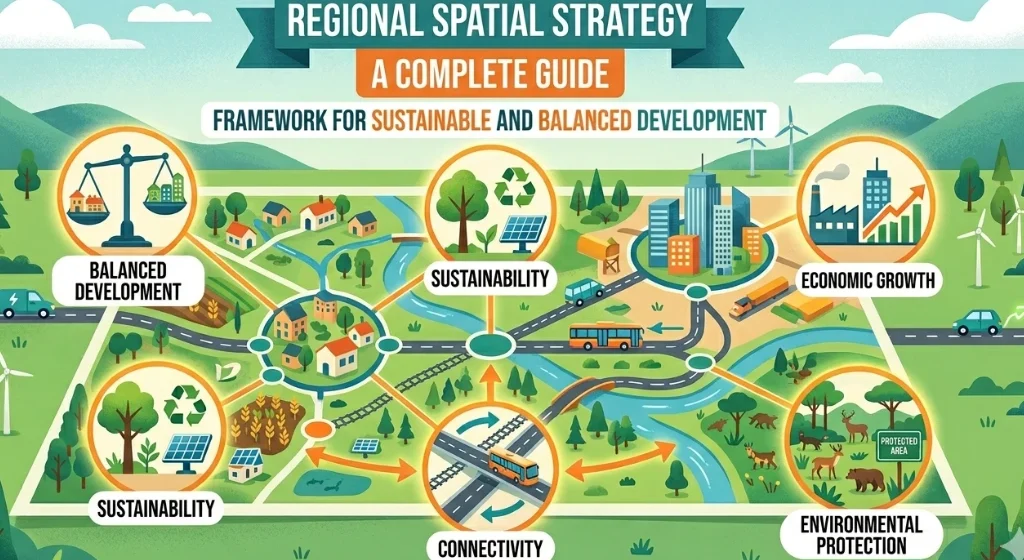
A Regional Spatial Strategy (RSS) is a detailed planning framework that helps guide how land, resources, infrastructure, and development should be managed across a region over a long period of time. Instead of focusing on just one city or town, it looks at the entire region as a connected system. This includes cities, towns, villages, and even rural and natural areas.
In simple words, a regional spatial strategy answers an important question: How can we develop a region in a smart, balanced, and sustainable way so that both present and future generations can benefit?
In this article, we will explain in detail, covering all important aspects such as planning principles, benefits, importance, urban development, sustainability, challenges, and future trends.
What is a Regional Spatial Strategy?
A regional spatial strategy is a long-term plan prepared by governments or planning authorities to manage the use of land and development across a region. It usually covers a period of 10 to 20 years or even longer. The purpose of this strategy is to ensure that development does not happen randomly but follows a clear and organized plan.
This plan involves the choice of the location of housing to be constructed, the location of industries, the development of a transport network, and the areas to be conserved due to environmental concerns. It is also based on economic growth, population increment and social needs.
For example, if a region is expecting rapid population growth, the strategy will identify suitable areas for new housing, ensure that infrastructure like roads and schools is available, and prevent overcrowding in already developed areas.
Key Planning Principles of Regional Spatial Strategy
Every regional spatial strategy is based on a set of planning principles that guide decision-making. These principles ensure that development is balanced, efficient, and sustainable.
Balanced Development
Balanced development means that growth should not be limited to major cities only. Instead, smaller towns and rural areas should also receive attention and investment. When development is balanced, it reduces pressure on big cities and creates opportunities in less developed areas.
For example, if industries are only built in one city, people from surrounding areas will move there, causing overcrowding. However, if industries are spread across the region, people can find jobs closer to their homes.
Sustainability
Sustainability is one of the most important principles of regional spatial strategy. It focuses on protecting the environment while allowing development to take place. This includes preserving forests, reducing pollution, managing water resources, and promoting renewable energy.
Sustainable planning ensures that natural resources are not overused and remain available for future generations.
Connectivity
Connectivity refers to how well different parts of a region are linked through transport systems such as roads, railways, and public transport. Good connectivity allows people to travel easily, supports trade, and improves access to services.
For example, a well-connected region will have efficient public transport that links rural areas with urban centers, making it easier for people to commute.
Efficient Use of Land
Land is a limited resource, so it must be used wisely. RSS promotes efficient land use by avoiding unnecessary expansion of cities (urban sprawl) and encouraging compact development.
This means building in a way that uses less land but provides more services and facilities.
Inclusivity
Inclusivity ensures that planning benefits all members of society, including low-income groups, marginalized communities, and people living in rural areas. It aims to provide equal access to housing, jobs, education, and healthcare.
Importance of Regional Spatial Strategy Today
In today’s world, regions are growing rapidly due to population increase, urbanization, and economic development. Without proper planning, this growth can lead to serious problems such as traffic congestion, pollution, and a lack of housing.
Regional spatial strategy significantly contributes to solving these issues.
One of its key importance is that it helps manage population growth in a structured way. Instead of allowing cities to expand randomly, it ensures that growth is planned and supported by infrastructure.
Another important aspect is environmental protection. With increasing concerns about climate change, an RSS helps protect natural resources and reduce environmental damage.
It also supports economic development by identifying suitable locations for industries and businesses.
Benefits of a Regional Spatial Strategy
A well-designed regional spatial strategy provides many long-term benefits for both people and the environment.
Improved Urban Development
One major benefit is improved urban development. Cities grow in a planned manner, which reduces problems such as overcrowding and poor infrastructure.
Better Infrastructure Development
Another benefit is better infrastructure development. Roads, public transport, schools, hospitals, and utilities are planned and developed efficiently, ensuring that people have access to essential services.
Promotion of Economic Growth
RSS also promotes economic growth by creating favorable conditions for businesses. When businesses are located in the right areas with good connectivity, they can operate more efficiently.
Environmental Protection
Environmental protection is another important benefit. By identifying and preserving green areas, forests, and water bodies, the strategy helps maintain ecological balance.
Improved Quality of Life
Finally, it improves the quality of life for people by providing better housing, transport, and public services.
Regional Spatial Strategy in Urban Development
Urban development is closely linked to regional spatial strategy. As cities grow, they need proper planning to accommodate increasing population and economic activities.
RSS helps guide urban development by identifying suitable areas for expansion. It ensures that new housing projects are built in locations with proper infrastructure and services.
It also helps reduce overcrowding in major cities by promoting development in nearby towns and smaller urban centers. This creates a more balanced distribution of population and resources.
For example, instead of allowing a city to expand endlessly, the strategy may encourage the development of satellite towns. These towns are connected to the main city through efficient transport systems and provide additional housing and employment opportunities.
How Regional Spatial Strategy Shapes Cities
The level of the influence of regional spatial strategy upon urban design and urban development is direct. It affects urban layout, location of various land uses, and the general form of the urban areas.
Organized and Structured Urban Growth
One of the key ways it shapes cities is by promoting organized growth. Instead of unplanned expansion, cities develop in a structured way with clearly defined residential, commercial, and industrial areas.
Improved and Integrated Transport Systems
It also improves transport systems by integrating different modes of transport, such as buses, trains, and roads. This reduces travel time and makes commuting easier.
Reduction of Informal Settlements and Slums
Another important impact is the reduction of informal settlements and slums. With proper planning, housing needs are addressed in advance, reducing the chances of unplanned settlements.
Stronger Regional Connectivity and Urban Networks
This spatial strategy also strengthens connections between cities and towns, creating a network of urban centers that support each other.
Role of Regional Spatial Strategy in Sustainable Growth
Sustainable growth means development that meets current needs without harming future generations. RSS plays a key role in achieving this goal.
Promoting Environmental Protection
It promotes environmental protection by preserving natural areas and reducing pollution. For example, it may restrict development in environmentally sensitive areas such as forests and wetlands.
Encouraging Renewable Energy Use
It also encourages the use of renewable energy sources such as solar and wind power. This helps reduce dependence on fossil fuels and lowers carbon emissions.
Enhancing Climate Resilience
Another important aspect is climate resilience. Regional spatial strategy helps regions prepare for natural disasters such as floods, droughts, and heatwaves by incorporating risk management into planning.
Balancing Economic Growth with Environmental Protection
Combining economic growth with environmental protection, it ensures long-term sustainability.
Challenges and Solutions in RSS
Despite its many benefits, the regional spatial strategy faces several challenges.
Political and Administrative Issues
One major challenge is political differences. Different regions and authorities may have conflicting priorities, making it difficult to implement a unified strategy. This can be addressed through better coordination and clear policies.
Lack of Funding
Another source of trouble is funding. Huge infrastructure projects involve huge investment which are not always accessible. This can be overcome with the help of the public-private partnership.
Rapid Urbanization
The pressure on planning systems is also brought about by rapid urbanization. Cities can develop at a faster rate beyond the expected provisions that cause gaps in infrastructure. This problem can be addressed by means of flexible planning approaches.
Public Resistance
Another problem is the resistance of the people. The potential opposition to land use or development activity can be observed among people. Trust and support could be facilitated by involving communities in the planning process.
Lack of Data and Technology
Finally, the absence of data and technology may impact the quality of planning. Decision-making can be enhanced through the use of current technology like Geographic Information Systems (GIS) and data analytics.
Future Trends in Regional Spatial Strategy
The future of regional spatial strategy is evolving with new technologies and changing global trends.
Smart Cities Development
The development of smart cities is one of the significant trends. Digital technologies enable these cities to enhance the quality of life, effective management of resources, and services.
Data-Driven Planning
There is also increased importance on data-driven planning. Real-time data is available to the planners to make pertinent decisions and address evolving circumstances.
Green Infrastructure
Another trend that is on the rise is green infrastructure. It involves parks, green roofs environment friendly buildings that enhance the environmental standard.
Transit-Oriented Development
Transit-oriented development is also becoming popular. The strategy is aimed at creating communities around transit stations to minimize the use of personal automobiles.
Regional Collaboration
Finally, regional collaboration is becoming more important. Cities and regions are working together to address common challenges and share resources.
Real-Life Example of Regional Spatial Strategy
To better understand how regional spatial strategy works, consider a region with one large city and several smaller towns.
Without proper planning, the main city may become overcrowded, with heavy traffic, pollution, and high housing costs. Smaller towns may remain underdeveloped.
With an RSS, development is distributed more evenly. Industries and businesses are encouraged to locate in smaller towns, creating jobs and reducing migration to the main city.
Transport systems connect all areas efficiently, allowing people to travel easily. Housing is developed across the region, and green areas are protected.
This results in a balanced, sustainable, and well-functioning region.
Conclusion
Regional spatial strategy is an essential tool for modern planning. It helps manage growth, improve infrastructure, support economic development, and protect the environment.
It makes development efficient and, at the same time, sustainable and inclusive by concentrating on the development of long-term planning and regional coordination.
The role of regional spatial strategy can only rise as regions expand and increase to meet new demands. It offers a blueprint on how to make the areas flawless, more human and future competent.
FAQs
1. What is a Regional Spatial Strategy (RSS)?
A Regional Spatial Strategy is a long-term plan that helps in the development of land, resources, and infrastructure in a region so as to ensure the growth is organized, balanced and satisfactory.
2. Why do regions need RSS?
Regions grow due to population increase, urbanization, and economic development. RSS prevents problems like overcrowding, traffic, pollution, and uneven development by planning growth strategically.
3. Who prepares an RSS?
RSS is prepared by governments or planning authorities, often in consultation with local communities, businesses, and experts.
4. How long does an RSS plan last?
Typically, it covers 10–20 years or longer, depending on the region’s growth projections and development goals.
5. What does RSS include?
- Where housing, industries, and businesses should be located
- Transport systems and connectivity between urban and rural areas
- Protection of natural resources and environmentally sensitive areas
- Infrastructure planning, such as schools, hospitals, and utilities
6. How does RSS benefit people and the environment?
- Balanced urban growth to prevent overcrowding
- Efficient infrastructure and public services
- Job creation through well-located industries
- Environmental protection and preservation of green areas
- Better quality of life with housing, transport, and amenities
7. How does RSS promote sustainability?
It ensures development meets current needs without harming the future by:
- Conserving forests, wetlands, and water resources
- Promoting renewable energy and reducing pollution
- Preparing regions for climate risks like floods or droughts
8. What challenges can RSS face?
- Political conflicts and administrative coordination issues
- Limited funding for large infrastructure projects
- Rapid urban growth exceeding planned capacities
- Public opposition to land-use changes
- Lack of accurate data for planning
9. How can RSS challenges be solved?
- Use clear policies and regional coordination
- Employ public-private partnerships for funding
- Apply flexible, data-driven planning
- Engage communities to build support and trust
10. What does the future of RSS look like?
- Smart cities using digital technologies
- Transit-oriented development to reduce car dependence
- Green infrastructure like parks and eco-friendly buildings
- Regional collaboration to share resources and solve challenges