
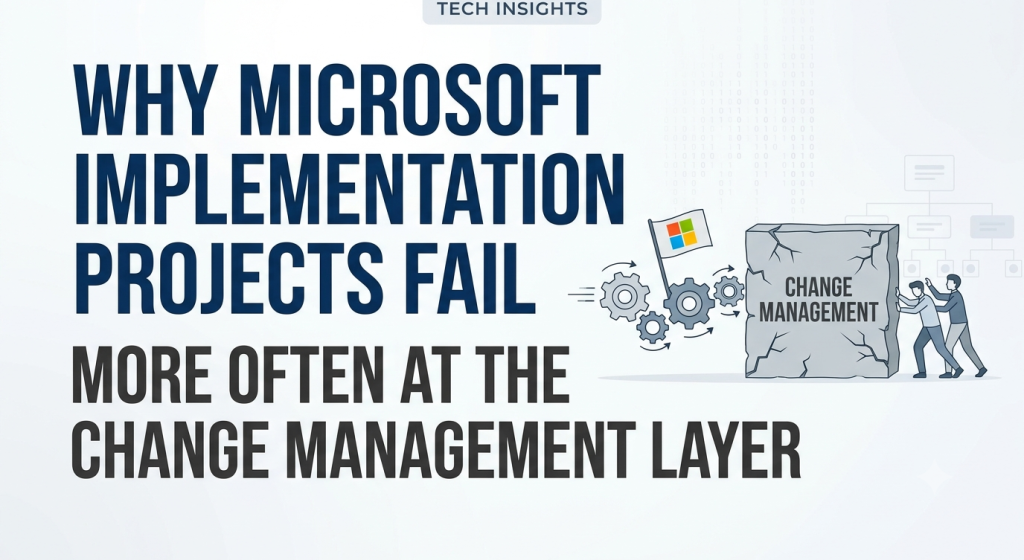
The technical configuration of a Microsoft implementation is the part of the project that gets the most attention, the most budget, and the most expert involvement. It’s also the part that most commonly succeeds while the project still fails to produce the business outcome it was commissioned to deliver. A Microsoft 365 tenant configured correctly, a SharePoint architecture built to specification, a Teams deployment completed on time and within budget — all of these represent technical successes that coexist regularly with implementation failures. These are measured by whether the target market is actually using it in ways that change how work gets done. That gap between technical completion and behavioral adoption is the change management layer, and it’s where Microsoft implementation projects most consistently fall short.
What Change Management Actually Involves in a Technology Implementation
Change management in a technology implementation is not the training sessions scheduled for the week before go-live. Those sessions are the visible portion of a process that should have started during the project’s scoping phase and that continues long after the go-live date in ways most implementation timelines don’t account for. The change management work that determines whether a Microsoft implementation produces lasting behavioral change begins with understanding how people currently work, what problems the new technology is supposed to solve for them specifically, and what the gap is between their current capability and the capability the new system requires.
That understanding is usually absent from implementation projects because it requires time, qualitative research, and stakeholder engagement that isn’t billable in the same way technical configuration is, and because the consultancies delivering the technical work are often not the same people responsible for the organizational change the technical work is supposed to enable. That structural separation between the technical delivery and the behavioral outcome is where the accountability gap opens, which allows both parties to declare success while the organization is still working around the system.
Why People Work Around New Systems
The workarounds that emerge after a Microsoft implementation are almost always rational responses to a gap between what the system requires of the user and what the user understands about why the system works that way. A person who doesn’t understand why they should store documents in SharePoint rather than on their local drive isn’t being resistant to change. They’re making a rational decision based on the information available to them, which is that their local drive works reliably for a task they’ve been completing without friction for years, and the new system requires behavior changes which compare whose benefit they haven’t experienced or understood.
A Microsoft consultancy engagement that leads with feature explanations misses the point entirely. The user’s actual workflows need to be mapped and addressed specifically before any feature demonstration means anything to the person sitting through it. Generic adoption support produces generic adoption rates, and an implementation that costs six figures in technical delivery deserves better than a few training sessions built around what the software can do in the abstract.
Where Implementation Timelines Create the Conditions for Change Management Failure
Most Microsoft implementation timelines are built around the technical milestones because those milestones are definable, measurable, and deliverable within the project budget. Change management milestones are harder to define and harder to measure, which means they tend to get compressed when the timeline is under pressure, deferred when the technical work runs longer than expected, and abbreviated when the budget is running short. Those compressions consistently occur at the end of the project, in the weeks around go-live, which is exactly when the change management investment would produce the most impact if it were present and when its absence produces the adoption problems that persist for months after the technical implementation is complete.
What the Post-Go-Live Period Requires That Most Projects Don’t Provide
The behavioral change that a Microsoft implementation is trying to produce doesn’t complete at go-live. It begins there, and the period between go-live and genuine behavioral adoption is where the change management investment either sustains the momentum the project created or allows the organization to drift back toward familiar patterns that the new system hasn’t yet replaced. Hypercare support that addresses specific adoption barriers as they emerge, champions within the organization who can provide peer-level support and modeling, and a measurement framework that tracks actual usage, are the post-go-live infrastructure that transforms a technical implementation into a genuine change in how the organization works.