
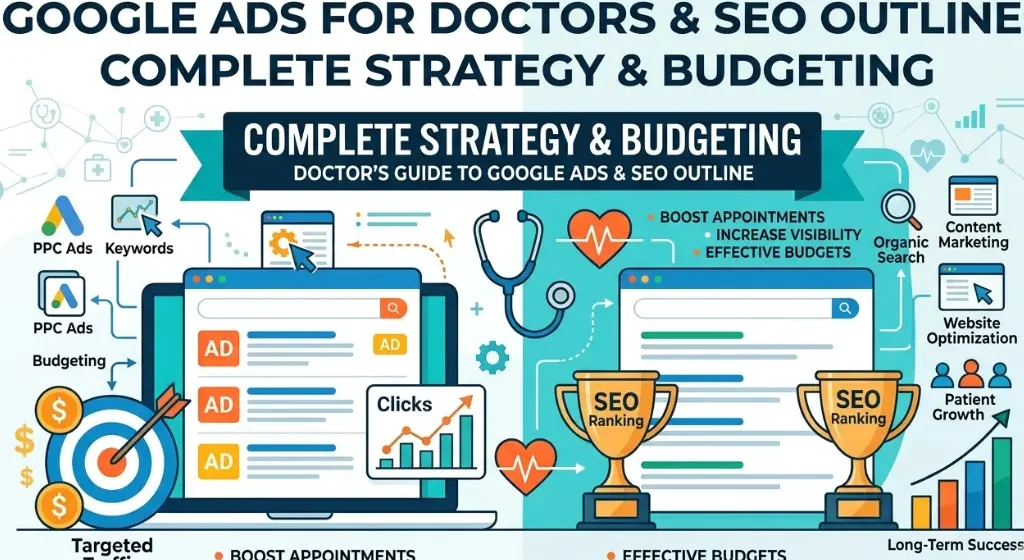
Understanding Google Ads for Doctors SEO Outline
A Google Ads for Doctors SEO Outline is a structured blueprint for marketing your practice online. It links paid campaigns to SEO so that all money spent drives qualified patient traffic and increases overall search visibility.
Key elements of this outline include:
- Keyword research targeting patients ready to book
- Campaign and ad group structure tailored to specialties
- Landing pages optimized for conversion
- Conversion tracking for calls and form submissions
- Ongoing bid management and optimization
This strategy will enable the clinics to maximize ROI and maintain a steady stream of appointments when implemented correctly.
Why Google Ads for Doctors SEO Outline Matters
The modern, digitally focused healthcare market does not allow patients to rely solely on referrals or insurance directories to locate physicians. Rather, they look online and use phrases such as “dermatologist near me,” “the greatest cardiologist in Houston,” or “open now urgent care.” Such searches show strong commercial intent; i.e., they are users willing to book at that moment.
Without a methodical process, medical practices are likely to lose customers to competitors and squander their marketing budgets. The solution is a comprehensive Google Ads for Doctors SEO Outline that combines paid search campaigns with organic SEO strategies. This is a combined strategy that guarantees short-term visibility, long-term control, and ROI.
By following a well-crafted strategy, clinics can:
- Capture high-intent patients efficiently
- Align paid campaigns with SEO for dual visibility.
- Reduce cost per acquisition (CPA)
- Scale marketing efforts with predictable results
Local Search Dominates Patient Acquisition in the U.S
Local search is also important since healthcare is a local industry. Patients would like to have physicians within reach as conveniently as they can access their insurance. The main figures would point out this trend:
- Over 77% of patients search online before booking appointments
- More than 60% of healthcare searches are mobile-based
- “Near me” searches for medical services continue to grow year over year
Practices in competitive cities such as New York, Los Angeles, Chicago, and Houston compete for the same high-intent keywords. Competition continues to increase even in mid-sized cities. Without local searches via Google Ads and SEO, the practices will go unnoticed by prospective patients.
The Complete Google Ads for Doctors SEO Outline Strategy
1. Keyword Research for Medical Services
Any campaign is based on keyword research. General words such as doctor or clinic have low intent traffic, whereas long tail keywords address patients who are willing to make a reservation.
Examples of high-intent keywords:
- “Pediatrician in Dallas accepting new patients.”
- “Orthopedic surgeon near me”
- “Emergency dentist Chicago”
Strategy tips:
- Include location-based keywords to target patients in your city or ZIP code
- Include service-based keywords to match treatment.s
- Include insurance-specific keywords for your accepted providers.
- Regularly refine with negative keywords to eliminate irrelevant searches.
2. Structuring Google Ads Campaigns for Doctors
A well-structured campaign will also ensure that budgets are used effectively and ads are sent to the appropriately targeted audience.
Campaign-Level Segmentation:
- Segment campaigns by medical specialty or clinic location
- Example:
- Campaign 1: General Practice
- Campaign 2: Specialized Treatments (e.g., dermatology, orthopedics)
- Campaign 3: Brand Protection (bidding on clinic name)
Ad Group Formulation:
- Break campaigns into specific treatments or conditions
- Example Ad Groups:
- Knee Pain Specialists
- Sports Injury Clinic
- Pediatric Orthopedics
- Knee Pain Specialists
Benefits:
- Ad copy matches patient intent
- Higher click-through rate (CTR)
- Lower cost per acquisition
3. Keyword Targeting and Match Types
Target long tail and exact match keywords to prevent the use of unnecessary funds. Broad match may show ads in response to an informational search, which will rarely convert.
Implementation tips:
- Use phrase match and exact match targeting
- Include location-specific modifiers: “near me,” city names.
- Refine campaigns with negative keywords: jobs, salaries, free advice, and home remedies.
4. Compliance with Healthcare Advertising Rules
Medical ads face unique compliance challenges:
- Retargeting patients is largely restricted
- Certain treatments require verification (e.g., Botox, weight-loss clinics, prescription drugs)
- Ads must avoid guaranteeing outcomes or using sensational language.ge
By ensuring compliance, you will safeguard your practice and avoidadversed disapproval or account suspension.
5. Optimizing Landing Pages for Patient Conversion
The conversion of patients on your site occurs only from paid clicks. Every advert must link to a specialized landing page for the treatment being sold.
Landing page best practices:
- Clear, engaging headline
- Doctor credentials and qualifications
- Services explained in simple, readable language
- Patient testimonials for social proof
- Insurance details and accepted plans
- Strong call-to-action (CTA): “Book Your Appointment Today.”
Conversion Tracking:
- Track form submissions
- Track phone calls using dynamic call tracking
- Track appointment scheduling
- Optimize layout for mobile devices (over 60% of searches are mobile)
6. Tracking Metrics That Matter
It is important to track the appropriate metrics, which are key to campaign success. Measure: avoid vanity metrics such as impressions and CTR.
- Cost Per Acquisition (CPA): cost per booked appointment
- Phone call conversions: track which keywords generate calls
- Form submission conversions
Using data to adjust bids, ad placements, and campaign performance is more likely to deliver better ROI.
7. Executing Your Patient Acquisition Strategy
A structured approach to patient acquisition includes:
- Audit current patient intake channels
- Identify high-margin treatments
- Conduct localized keyword research.
- Draft 3 ad variations per top service
- Launch campaigns using exact match keywords
- Daily monitoring of search terms to exclude irrelevant clicks
- Adjust bids based on device, location, and time
This ensures a steady flow of qualified patients without overspending.
8. Budget Planning for Google Ads in the USA
U.S. cost considerations:
- CPC varies by specialty:
- Low-competition services: $2–$8 per click
- High-competition services: $10–$50+ per click
Monthly budgets:
| Practice Type | Ad Budget | Management Fee |
| Small Clinic | $1,500–$3,000 | $500–$1,200 |
| Mid-Sized Practice | $3,000–$7,000 | $1,000–$2,000 |
| Multi-Location | $8,000–$20,000+ | $2,000–$5,000 |
SEO service costs:
- Local SEO: $800–$1,500/month
- Advanced SEO: $1,500–$3,500/month
- Multi-location SEO: $3,000–$8,000/month
Smart Bidding Strategies:
- Target CPA for predictable cost per appointment
- Maximise Conversions to increase patient volume
- Enhanced CPC for new campaigns with limited historical data
6 Common Mistakes to Avoid in Google Ads for Doctors SEO Outline
Even well-meaning campaigns cannot work when these pitfalls are not considered. By not using them, you will keep your advertisements affordable, efficient, and easy to expand:
- Targeting too broad an audience: Advertisements placed in front of a general audience tend to waste money and drive clicks from non-booking users. Target on place-oriented, niche-driven, and high-motivation keywords.
- Ignoring negative keywords: Your ads can be displayed to job seekers, researchers, or informational searchers without filtering out irrelevant searches, which can lead to increased Cost Per Acquisition (CPA) for no reason.
- Sending paid traffic to a generic homepage: Users’ search queries need to match the landing pages. An ordinary homepage does not make clicks translate to appointments. Specific services have customized, optimized landing pages that enhance conversion rates.
- Choosing the cheapest marketing provider: Low-cost services can cut corners, leading to poor keyword research, ad copy, or targeting. Special-purpose healthcare marketing can be invested in with ROI guarantees.
- Overlooking local SEO: The visibility of local search results is paramount for doctors. To avoid showing up in near-me searches and local maps, which are significant sources of high-intent patients, you have to ignore them.
- Not tracking conversions effectively: It is misleading to focus only on clicks or impressions. Submission of track forms, making of phone calls and booking of appointments to ensure minimum errors in terms of maximization of profits.
By addressing these mistakes in your Google Ads for Doctors SEO Outline, you can reduce wasted spend, improve patient acquisition, and ensure campaigns are structured to scale efficiently over time.
Google Ads vs SEO for Doctors Comparison
| Factor | Google Ads | SEO |
| Speed | Immediate visibility | 3–6 months |
| Cost | Pay-per-click | Long-term investment |
| Stability | Stops when the budget stops | Long-lasting ranking |
| Best For | Quick patient acquisition | Authority and trust building |
A combination of paid advertisements to get an appointment immediately and SEO to be seen in the long run is the optimal approach.
Choosing the Right Agency
Selecting the right agency is critical for a successful Google Ads for Doctors SEO Outline. Look for a partner who offers:
- Healthcare expertise and HIPAA compliance: To conduct successful and safe campaigns, the agency should be aware of medical regulations, terminology, and patients’ privacy needs.
- Transparent reporting: Look forward to clear cost-per-lead, call-tracking, and conversion performance metrics to determine the real ROI of your campaigns.
- A clear, results-driven strategy: It is always important to focus on booked appointments and the acquisition of patients rather than on clicks or impressions.
- Proven case studies: Find other cases of comparable medical practices that had quantifiable outcomes and were adequately returned on investment.
The collaboration with the experienced, expert agency will make their campaigns effective, compliant, and profitable in the first place. It will allow your practice to develop sustainably with minimal losses from wasted advertising costs.
Google Ads & SEO Strategies for High-Intent Patient Acquisition
The competitive healthcare market today is not full of digital marketing agencies that are equal. What makes Frack Technologies and Vaphers unique is that their model is more on a patient acquisition basis that is quantifiable as opposed to based on several clicks or impressions. Here’s what sets them apart:
- Custom Google Ads strategy centered on patient acquisition: Each campaign is specific to your clinic, target market, and local market. This will ensure that advertisements are shown to high-intent patients who are willing to make appointments.
- Advanced keyword clustering for medical SEO: The most relevant long-tail or location-based keywords are matched with medical practices through advanced keyword research, improving paid and organic visibility.
- Landing pages designed for high conversion: With a landing page dedicated to trust, clarity, and a smoother booking process, every service/treatment has its own landing page that turns ad clicks into actual appointments.
- Ongoing optimization and detailed reporting: Campaign performance, including CPA and conversion rates, will be continuously analyzed to maintain ad efficiency, cost-effectiveness, and regulatory compliance.
- Full-service approach: PPC, SEO, CRO: Rather than managing the paid campaigns independently, they combine the search engine optimization, paid advertising, and optimization of the conversion rates to form a whole patient-acquisition funnel.
This combined performance-based strategy will also ensure increased ROI, higher-quality patient leads, and long-term, sustainable growth for medical practices, making your clinic a clear leader over competitors.
Frequently Asked Questions (FAQs)
1. How much should a doctor spend on Google Ads in the USA?
A local clinic should be able to gather efficient data and produce regular patient leads, which would require a minimum of $1,500–$1,600 per month in most medical practices. Mid-sized practices might need to pay between $3,000 and $7,000 per month, whereas multi-location practices might pay between $8,000 and $20,000 per month or more. Your specialty, rivalry and geography will determine the reality.
Using a structured SEO Outline ensures this budget is spent efficiently, targeting high-intent patients and minimizing wasted spend. Smart bidding and sufficient keyword segmentation also help keep the cost per acquisition (CPA) predictable.
2. Is SEO better than Google Ads for doctors?
SEO should be used alongside Google Ads, as they serve different purposes. SEO offers short- and long-term visibility through organic rankings and builds trust over time, whereas Google Ads offers immediate patient leads and traffic. When the market is highly competitive, waiting months to see results from merely using SEO would be of no value.
Combining both strategies in a Google Ads for Doctors SEO Outline ensures your practice captures high-intent patients immediately while simultaneously building organic authority. Finally, the optimal practice will be the one that incorporates the short-term positions with long-term development.
3. How long does medical SEO take to work?
It typically takes 3-6 months to achieve significant results in medical SEO, depending on the competition, the city’s size, and the target number of keywords. In a very competitive niche or in a city, it can take longer to appear on the first page.
Following an SEO Outline helps accelerate results by using paid campaign data to inform keyword strategy and landing page optimization. Ongoing content generation, technical SEO, and backlink building also rank higher. Constant optimization and patience are essential to long-term visibility.
4. Are medical keywords expensive in the U.S.?
Medical keywords are competitive; yes, it is true. CPC rates can be as low as 10, 5,0 or 0 per click, depending on the type of specialized procedure, cosmetic treatment or urgent care; the specialty may be less competitive, aiding in lowering costs to 2 8 per click.
A structured Google Ads for Doctors SEO Outline helps target long-tail and local keywords, reducing unnecessary spend and improving ROI. Adding negative keywords helps avoid adverts for irrelevant searches. Even high-cost keywords can drive profitable patient appointments with proper strategic planning.
5. Do doctors need separate landing pages for each service?
Yes, a landing page should be dedicated to each core service. A generic homepage would reduce conversions, as the message might not align with the patient’s needs. There should be a clear call to persuade patients to seek medical services, using optimized landing pages that include a service description, doctor qualifications, patient testimonials, insurance contact details, and a call to action.
Your Google Ads campaigns can be associated with every page, every ad group, and each search query, which will boost your quality scores and lower your cost per acquisition. This will guarantee that each click has a high probability of resulting in a booked appointment.
6. Can small clinics compete with large hospitals?
Absolutely. Competitive opportunities open to small clinics will be local targeting, niche specialization, and perfect campaigns. A clear Google Ads for Doctors SEO Outline helps identify high-intent patients in your area and tailor ads specifically for them.
The emphasis on unique selling points, such as same-day appointments, personalized care, or special treatments, differentiates the smaller practices. Local search also enhances appearance in the local search results. Small clinics can create a steady patient flow without a hospital’s huge budget with the right strategy.
Conclusion: Budgeting and Strategy for Maximum ROI
A well-executed Google Ads for Doctors SEO Outline is more than just running ads—it is a comprehensive, data-driven marketing strategy designed to generate high-quality patient leads while ensuring every dollar spent contributes to measurable growth. Effective campaigns entail thorough planning, tactful execution and constant optimization that produce unified outcomes in a competitive healthcare marketplace.
Key strategies to implement:
- Define clear patient acquisition goals and track CPA. Begin by setting quantifiable goals for new hires and turnover. Performance: Cost Per Acquisition (CPA): You want to track which campaigns are profitable and scalable.
- Segment campaigns by speciality and treatment: Enhance your campaigns and ad groups by aligning them with specific services or medical specialities. This enables accurate targeting, more relevant ad copy, and improved ROI.
- Integrate paid campaigns with organic SEO: Enhance both your Google Ads and SEO strategies to be seen twice: paid ads drive immediate leads, and organic search ensures sustainable growth.
- Optimize landing pages for maximum conversions: Every service or treatment must have a dedicated landing page with well-defined messaging, doctor qualifications, patient reviews, and powerful calls to action. This will ensure that the clicks convert into booked appointments.
- Allocate budgets strategically with smart bidding: Get the most out of your budget and scale efficiently with target CPA, maximize conversions, and Enhanced CPC strategies.
- Partner with a specialized medical marketing agency: These agencies offer expertise in healthcare regulations, HIPAA compliance, and cutting-edge digital advertising methods, ensuring campaigns are efficient and compliant.
By following a structured Google Ads for Doctors SEO Outline, practices can not only increase patient acquisition but also reduce wasted ad spend, enhance brand visibility, and maintain long-term growth. This business tactic will ensure that all campaigns are optimized, compliant, and effective, providing your medical practice with a competitive advantage in the current digital-first healthcare marketplace.