
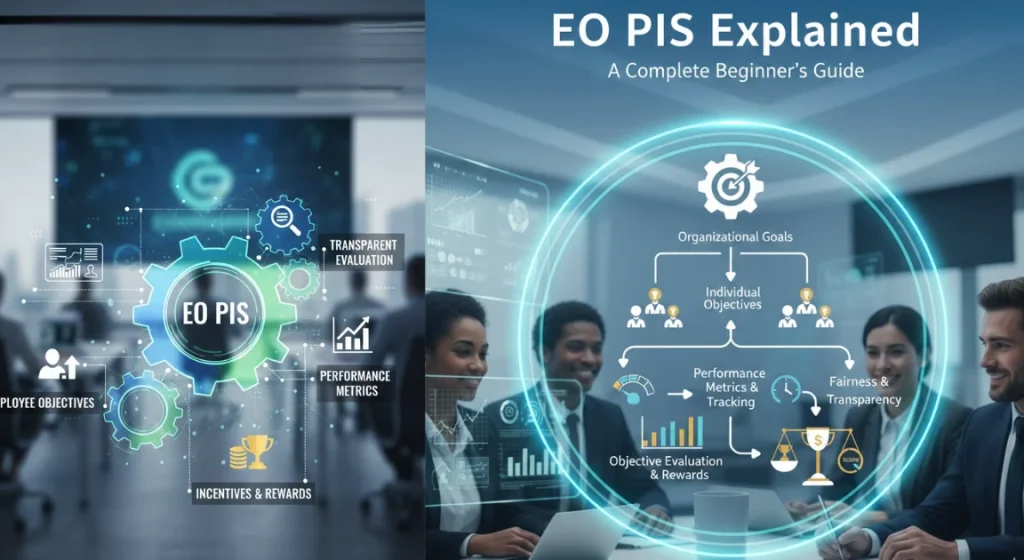
Introduction
The appreciation of employee incentives systems is gaining more significance in the modern business world. Firms are persistently seeking organized means of rewarding performance, maintaining talent and establishing objectives of employees with the success of the organization. EO PIS (Employee Objective -Performance Incentive System) is one of such systems that is gaining popularity as a means of enhancing productivity, motivation, and accountability in organizations.
This tutorial is created with a particular purpose of writing to beginners because people desire to have a good explanation that is in depth, without all these jargons. At the close of this article, you will have a good understanding of what EO PIS entails, its operations, why organizations implement it and the advantages of it to both the employees and the employers.
What Is EO PIS?
EO PIS is an acronym (employee objective – performance incentive system). It is an organized performance management and reward system that connects employee goals with measurable performance outcomes and rewards.
In its essence, it stitches personal employee objectives and sets organizational objectives. It integrates objective rating scales with performance money as a means of providing a transparent and measurable working environment.
This is based on fairness, consistency, and clarity unlike in traditional appraisal systems where relying on subjective assessment is a significant priority in the appraisal system. The employees are aware of what they should do, how their performance will be evaluated and what types of rewards they can get depending on the results.
The Purpose Behind EO PIS
The main aim of EO PIS is to establish a good fit between individual performance and organizational achievement. Productivity and accountability automatically improve when employees have a clear picture of the ways their contribution affects the business objectives.
Key objectives include:
- Encouraging measurable and goal-oriented performance
- Improving employee motivation and engagement
- Supporting fair and performance-based reward distribution
- Enhancing transparency in evaluations
- Strengthening long-term organizational growth
Why Organizations Are Moving Toward Structured Incentive Systems
The contemporary workplaces are changing fast. The old models of the salaries-only can no longer be used to retain talented professionals. Companies are moving towards organized systems such as EO PIS due to their display of sanity, justice and responsibility.
Companies benefit from:
- Reduced employee turnover
- Better alignment between employee goals and business objectives
- Improved morale and workplace engagement
- Data-driven performance and compensation decisions
This change signifies a greater trend toward performance-based and result-based organizational cultures.
Key Components
A practical EO PIS framework consists of a number of key components that interact to provide effectiveness and equity.
Performance Indicators
The performance indicators are clearly defined and measurable in each role. These can be productivity, quality, efficiency or behavioral measurements.
Evaluation Periods
Reviewing performance is done after some predetermined time periods, such as monthly, quarterly, or annually. Frequent assessments assist in ensuring consistency and giving feedback in time.
Scoring and Weightage
The weight is placed on each area of the performance so that there is also a balanced assessment, and that a single factor is not too important.
Incentive Mapping
The performance scores are directly associated with rewards and incentives, which assure transparency, predictability, and equitableness.
How EO PIS Works Step by Step
It has a well-organized working process. All of these stages help to eliminate any ambiguity, make things more just, and keep the employees aligned with organizational success. Each of the stages is discussed below.
Defining Organizational Goals
First is establishing measurable goals of the organization. Such objectives can be connected with revenue increase, headway of productivity, client satisfaction, quality benchmarks, or functionality.
Goals are clearly defined, and this will give both the management and employees a clear direction.
Aligning Individual Employee Roles with Goals
As soon as the organizational goals are set, they are divided into role-based objectives. Every employee is given responsibilities that will have a direct contribution to the general targets of the company.
This cohesion would help to make each employee realize the effects their day-to-day activities have on the overall business performance.
Assigning Performance Metrics and Objectives
Once role alignment has been done, specific performance metrics are put down. These metrics are quantifiable and performance-based, i.e., quantity of output, quality of work, efficiency, deadlines, or conduct standards.
It is easy to measure things, and it makes the employees concentrate on what really matters.
Continuous Performance Tracking
Stresses continuous performance review as opposed to periodic evaluations. The reports, dashboards, or management systems are used to track performance data on a regular basis.
With constant monitoring, feedback, correction, and support are made in time, which avoids the last-minute surprises during evaluations.
Conducting Objective Evaluations
Performance is measured at pre-programmed intervals (monthly, quarterly, or annually) using data collected and based on pre-prescribed criteria.
Since ratings are done in objective basis, chances of personal bias and favoritism are reduced, thus more trust in the system is achieved.
Distributing Incentives Based on Results
The last one is incentive distribution. The bonuses, rewards, promotions or recognition are granted purely based on the performance scores.
Employees are well aware of the relationship between hard work, performance, and reward that reinforces motivation and responsibility.
Ensuring a Fair and Systematic Process
This step-by-step strategy will allow EO PIS to make performance appraisal organized, clear, and objective.
This will be a systematic procedure that substitutes prejudiced or random judgments with informed decisions to the benefit of both the workers and employers.
Benefits for Employees
From an employee’s perspective, it offers clarity, fairness, and motivation. Employees are no longer left guessing how promotions, bonuses, or incentives are decided.
Major benefits include:
- Clear performance expectations
- Fair and transparent rewards
- Increased motivation and job satisfaction
- Opportunities for professional growth
- Stronger trust in management
Emphasis on recognition and fair reward will naturally increase engagement and productivity as the employees involved will feel that their efforts have not gone to waste.
Benefits for Employers
Employers also gain significant advantages by implementing EO PIS within their organizations.
Key benefits include:
- Higher productivity and efficiency levels
- Objective and data-driven performance measurement
- Improved workforce planning and talent management
- Stronger performance-oriented culture
- Better and faster decision-making
This is to assist the management in recognizing high performers, but also assist those employees who require betterment.
EO PIS vs Traditional Performance Appraisal Systems
The conventional performance appraisal management is usually based on personal opinions and yearly appraisals. EO PIS, on the other hand, focuses on constant check-ups and quantifiable results.
| Aspect | Traditional Appraisal | EO PIS |
| Evaluation Method | Subjective | Objective |
| Frequency | Annual | Periodic |
| Transparency | Limited | High |
| Employee Motivation | Moderate | Strong |
This analogy explains why contemporary organizations want structured systems such as the EO PIS.
Common Challenges in Implementation
Despite all the benefits that EO PIS has, organizations can also experience some issues when the implementation of the system is not done correctly. Learning these challenges in advance can prevent pitfalls and also enable the companies to be prepared.
Poor Metric Design
Poorly designed performance measurements can be considered as one of the most frequent challenges. When indicators are vague, unrealistic or not compatible with the fundamental job role, then employees may get confused or discouraged.
A proper system should have measures that can be measured, can be achieved and that are directly related to the tasks of the employees. The creation of bad metrics might result in unjust measurements and a lack of confidence in the system.
Lack of Clear Communication
This system can be effective only if the employees are well-versed in the operation of this system. When there is a lack of communication of goals, evaluation criterion or incentive structure, then the employees will find themselves in misunderstandings with possible expectations.
The absence of communication usually leads to confusion, resistance, and the display of skepticism, thus undermining the success of the whole system.
Resistance to Change
The introduction of EO PIS can require the change of traditional approaches to appraisal to the systems of performance-based assessment. Other employees/managers might be resisting such change due to fear of accountability or being uncomfortable with transparency.
The unwillingness to change is typical, yet it may slow down the adoption process and make systems less efficient without adequate guidance and support from the leaders.
Data Management and Tracking Issues
It is very dependent on performance data that is accurate. Evaluations would be inconsistent or inaccurate in the absence of correct data collection, tracking tools, or reporting systems.
Lack of proper data management may cause inaccurate performance ratings, withheld incentives and displeasure among the employees.
Managing Challenges Effectively
Despite these challenges, EO PIS can be implemented successfully with proper planning. These challenges notwithstanding, it can succeed in its implementation with planning. Overcoming these challenges in organizations is achieved through training, setting realistic measures, open communications and making use of effective tracking systems.
As soon as the challenges are dealt with in advance, it becomes a strong tool of performance and trust creation.
Best Practices for Successful Implementation
Organizations can maximize the success of EO PIS by following proven best practices.
- Define clear, realistic, and achievable goals
- Involve employees in the planning and design process
- Maintain transparent and ongoing communication
- Review and refine performance metrics regularly
- Provide constructive feedback along with incentives
These practices encourage acceptance, trust, and long-term sustainability.
Industries Where EO PIS Is Commonly Used
This system is widely adopted across various industries, including:
- Corporate offices
- Manufacturing units
- Financial institutions
- Technology companies
- Sales and marketing organizations
Its flexibility allows organizations to customize the system according to industry-specific needs.
Future of Performance Incentive Systems
The structured system, such as EO PIS, is likely to be further developed as businesses continue to depend more on data and analytics. Fusion of online platforms, artificial intelligence analytics, and live performance indicators will increase precision and justice.
The performance management future is in the direction of intelligent, high-speed and transparent incentives.
Conclusion
The modern world of performance requires organizations to have performance-rewarding systems that promote responsibility, encourage diligence and nurture development. These goals may be met through EO PIS (Employee Objective -Performance Incentive System), which is a structured and transparent method.
This brings about a win-win situation for both the employees and their employers by substantially connecting employee objectives, performance measures, and rewards. To someone new, some form of familiarity with this framework is a pre entry to the appreciation of the current performance management practices. This system can be used to change the workplace culture, increase motivation and achieve organizational success in the long term when used correctly.
Frequently Asked Questions
Is EO PIS compulsory?
No, it is not compulsory; however, it is most strongly advised for performance platform organizations.
Is EO PIS only for bonuses?
No, it consists of promotions, development, recognition and long-term incentives.
What is the difference between EO PIS and KPI?
KPIs are a measure of performance, and EO PIS ties the performance measures to quantifiable rewards.
Can EO PIS demotivate employees?
Yes, unrealistic targets, late incentive delivery, and negligence of the feedback.
Who manages EO PIS in an organization?
Managers, design and compliance monitor performance are managed by HR, whereas employees are engaged in goal-setting.