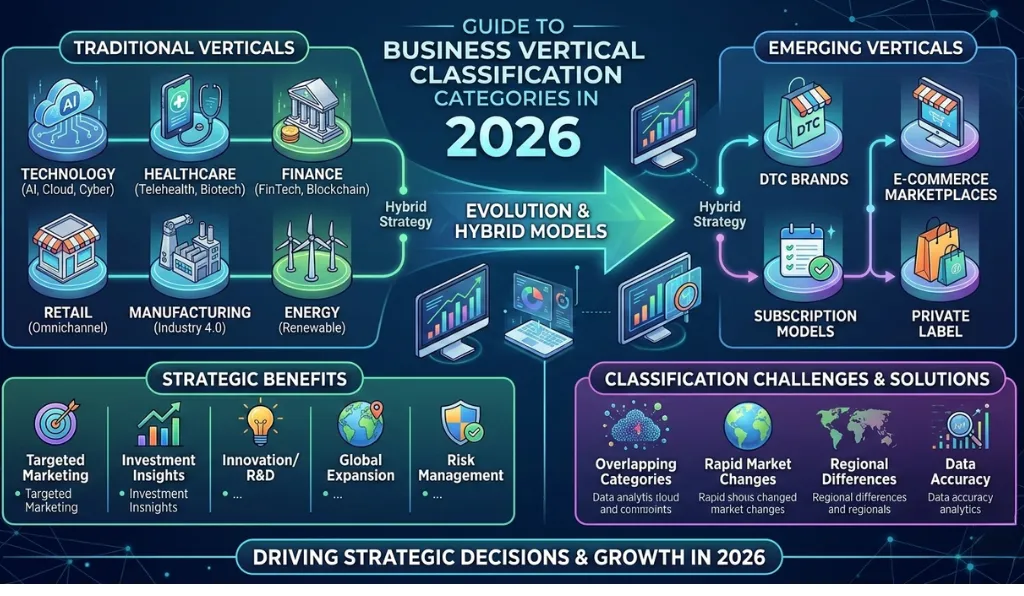
In the competitive global economy today, the knowledge of industries and market segments is no longer a prerogative but an absolute requirement in the business world. Structured industry understanding aids organizations, investors and policy makers in making strategic plannings or decisions. One of the most effective ways to analyze markets is through Business Vertical Classification Categories. Such classifications categorize companies by industry or sector based on similarities such as shared products, services, target customers, and working models.
As technology, consumer behavior, and business models rapidly evolve, 2026 will be a pivotal year in defining the verticals. New vertical classifications have been introduced to integrate the old industries and new and pending technology models. This comprehensive guide explores the key business vertical classification categories for 2026, their significance, and how organizations can capitalize on them to drive growth and competitiveness.
What Are Business Vertical Classification Categories?
A business vertical is a specific industry or market in which a company operates. Vertical classification means grouping businesses into similar categories based on what they do or who their customers are.
For instance:
- A company developing financial software is part of the FinTech vertical.
- The Sustainable Consumer Products vertical covers businesses that manufacture environmentally friendly household products.
Differentiation of businesses into verticals enables companies to identify competitors, track market trends, identify opportunities, and operate the business efficiently.
Why Are Business Vertical Classification Categories Important?
In the modern business environment that is evolving fast, it is no longer sufficient to know the industry within which a firm operates. The knowledge and use of vertical classifications enable organizations to make smarter decisions, discover opportunities, and have an upper hand. Vertical classifications will not only classify data by the year 2026 but also spur growth and development strategies. Here’s why this is crucial:
1. Targeted Marketing and Customer Engagement
Among the most direct advantages of vertical classification, the flexibility of marketing strategies posed before a particular audience needs to be mentioned.
- How it works: Learning the vertical would enable the business to identify the specific pain points, preferences, and behavior of its target customers. Indicatively, advertising of a medical SaaS business will be totally different from advertising a luxury clothing brand.
- Impact: This accuracy increases engagement rates, improves conversion, and optimally allocates ad spend. Individual campaigns, email, and social media campaigns can be tailored to the vertical audience.
- Example: A DTC skincare brand that serves environmentally conscious customers can optimise its sustainability messaging, whereas a tech hardware brand can target IT managers by basing its promotional efforts on performance and safety.
2. Investment Insights and Strategic Resource Allocation
Vertical classifications are extremely important to investors and senior corporate decision-makers for determining high-potential sectors.
- How it works: With this verticalization of the business, it becomes easier to compare growth opportunities, market size, and risk levels across similar businesses.
- Impact: Shareholders can make sound decisions, invest capital efficiently, and reduce the risk of overexposure to poor-performing sectors. Individual businesses can pinpoint which verticals are getting capital and expand accordingly.
- Example: It is projected that AI-based FinTech systems will be more heavily invested in 2026 than software used by traditional banks, due to rapid adoption and high growth potential, underscoring the importance of vertical insights.
3. Regulatory Compliance and Risk Management
Every vertical usually has certain legal, safety and regulatory requirements. This may result in a lack of compliance, fines or repairs to the images.
- How it works: Knowing the vertical means the firms know what the industry requires in terms of regulations, certifications, and reporting standards.
- Impact: This will minimize legal risks, ensure operational continuity, and cultivate trust among stakeholders.
- Example: The guidelines that a pharmaceutical company should follow are extensive due to FDA regulations, whereas the main issues that a tech startup focused on developing software related to gaming should address include legal requirements related to digital copyright or privacy. Proper classification will make businesses compliant.
4. Innovation, Research, and Development (R&D)
Vertical categorization is essential for strategic innovation, as it highlights market gaps and opportunities.
- How it works: By understanding the needs and constraints of their vertical, business entities can identify unmet needs and create new products or enhance existing solutions.
- Impact: Focused R&D will create innovations that vertical customers will accept, driving more adoption and market share.
- Example: Within the healthcare vertical, AI-based diagnostics and precision medicine are being developed to address findings from a comprehensive examination that revealed gaps in personalized care. On the same note, food delivery services with subscription plans are innovative in developing meal plans tailored to the specific dietary requirements of the target group.
5. Strategic Global Expansion
Vertical classifications help businesses enter international markets more effectively.
- How it works: A vertical company’s performance across regions can help it identify markets in high demand and low competition. They can also customize products and services to regional tastes within that vertical.
- Impact: This guarantees higher success in market entry, higher ROI, and reduced operational risk.
- Example: DTC wellness brand will be rejoicing in the knowledge that subscription-based health supplements are currently thriving in North America, whilst Southeast Asian e-commerce marketplaces are becoming more open to cost-effective beauty products. Knowledge of the vertical trend enables data-driven strategic expansion.
6. Competitive Intelligence and Strategic Positioning
Correct vertical classification also offers information on competitor strategies and market forces.
- How it works: By knowing who falls under the same verticals, they can benchmark, identify best practices, and uncover differentiating areas.
- Impact: This results in greater competitive advantage, better differentiation, and the ability to anticipate market changes.
- Example: The e-commerce marketplace vertical is a good one for a newcomer to analyze competitors’ pricing, logistics, and customer contact policies when formulating a unique value proposition.
The organization of data in a vertical fashion is no longer confined to classifying business verticals by 2026. It is already a strategic resource that enlightens marketing, investment, regulation, invention, growth, and competitive planning. Companies that utilize correct vertical insights are in a good position to:
- Understand and engage their target audience.
- Allocate resources wisely and attract investment.
- Innovate with precision and efficiency.
- Enter new markets with confidence.
- Stay ahead of competitors in a rapidly evolving global landscape.
Ultimately, vertical classifications are a lens through which companies can see opportunities, threats, and strategic benefits; hence, they cannot be ignored to secure growth and market dominance.
Traditional Business Vertical Classification Categories
Traditionally, business divisions were determined by major industry participants. These categories served the companies’ purpose of learning their markets and competitors, as well as their areas of growth.
Although traditional verticals are still going, they have broadly moved beyond their roles as they embrace technology, digital tools, and data-driven insights. The analysis of verticals should not be limited to traditional and modern factors that should guide businesses in remaining relevant in 2026.
1. Technology and IT Services
The technology vertical offers an extensive service portfolio, including software development, cloud computing, cybersecurity, IT consulting, and SaaS solutions. Technology has remained one of the major sources of innovation in industries.
2026 Trends in Technology
- AI and Machine Learning Integration: Machine learning and AI are finding applications across fields, automating processes, analysing data, and enhancing decision-making.
- Cloud-Based Platforms: Enterprises are starting to depend on cloud providers to spin up and spin down, and to deliver cost-effective operations.
- Cybersecurity and Data Protection: Securing digital assets is a strategic priority, as cyber threats are becoming increasingly complex.
Subcategories
- Cloud Services
- Artificial Intelligence & Machine Learning
- Cybersecurity Solutions
- IT Consulting & Outsourcing
2. Healthcare and Life Sciences
Healthcare is a highly dynamic and sensitive vertical that covers hospitals, pharmaceuticals, biotechnology, telemedicine, and wellness solutions. The sector is undergoing rapid transformation due to technological innovation and the diversification of patient needs.
2026 Focus in Healthcare
- Telehealth Services: Remote monitoring and consultation are the new norm.
- Personalized Medicine: The use of genomic research enables the treatment of individual patients in a professional manner.
- AI-Assisted Diagnostics: Artificial intelligence helps enable better, more efficient diagnostics.
Subcategories
- Hospitals & Clinics
- Pharmaceuticals
- Medical Devices
- Digital Health & Telemedicine
3. Financial Services
The financial services vertical comprises banking, insurance, investment, and new FinTech solutions. Online disruption of the sector, regulations and technology are all significant.
Emerging Trends in Finance
- Blockchain and Digital Currencies: These technologies are redefining traditional banking and payment systems.
- Robo-Advisors: Automated wealth management solutions are gaining popularity.
- Cybersecurity: Protecting sensitive financial data remains a top priority.
Subcategories
- Banking & Credit Services
- Insurance & Risk Management
- FinTech & Digital Payments
- Investment & Asset Management
4. Retail and Consumer Goods
Retail involves the use of both physical and digital platforms for consumer products, fashion, and luxury goods. This vertical is undergoing an omnichannel adoption and adapting to new consumer expectations.
2026 Trends in Retail
- Omnichannel Strategies: The combination of online and offline experiences ensures a smooth customer experience.
- AI-Driven Recommendations: Personalization Improves Engagement and Sales.
- Sustainability and Ethical Sourcing: Consumers are increasingly choosing brands committed to sustainability.
Subcategories
- Consumer Goods & Products
- Fashion & Apparel
- Luxury Retail
- Specialty Stores
5. Manufacturing and Industrial Goods
Another basic vertical is manufacturing, which is changing towards automation, IoT, robotics, and 3D printing. These technologies increase productivity, efficiency, and product quality.
Key Drivers in Manufacturing
- Smart Factories: Automation and data analytics optimize production processes.
- Sustainable Practices: Reducing waste and energy consumption are growing priorities.
- Supply Chain Automation: Superior delivery logistics and AI to minimize costs.
Subcategories
- Automotive & Aerospace
- Electronics & Machinery
- Chemicals & Materials
- 3D Printing & Industrial Robotics
6. Energy and Utilities
The energy vertical encompasses both conventional sources, such as oil and gas, and renewable energy sources. The key areas of concern in 2026 are sustainability and efficiency.
2026 Trends in Energy
- Renewable Energy Growth: The overall use of solar, wind, and hydro solutions is increasing worldwide.
- Smart Grids and Energy Storage: High-power grid and storage enhance efficiency.
- Decentralized Energy Systems: Resilience is provided by microgrids and local energy generation.
Subcategories
- Oil & Gas
- Renewable Energy
- Utilities & Power Distribution
- Energy Storage & Smart Grids
7. Transportation and Logistics
Transportation includes rail, supply chain management, shipping and aviation. The vertical is at the forefront of automation and digital solutions.
Trends in 2026
- Autonomous Vehicles and Drones: Technology Improves Last-Mile Delivery Efficiency.
- Smart Logistics: AI-driven analytics optimize routes and reduce costs.
- Sustainable Transportation: Eco-friendly solutions reduce carbon footprint.
Subcategories
- Shipping & Freight
- Air & Rail Transport
- Last-Mile Delivery
- Logistics Tech & Supply Chain Management
8. Real Estate and Construction
PropTech solutions combine real estate, property development, and technological development.
2026 Insights
- Smart Buildings: IoT-enabled homes improve comfort and efficiency.
- Energy-Efficient Construction: Green designs and materials help mitigate environmental impacts.
- PropTech Solutions: Online technology streamlines real estate.
Subcategories
- Residential & Commercial Real Estate
- Construction & Engineering Services
- Property Management
- Real Estate Technology (PropTech)
9. Media and Entertainment
This vertical encompasses the digital media, streaming, gaming, publishing and advertising. Technology continues to transform the way content is produced and consumed.
Emerging Trends
- Streaming Platforms: OTT services dominate global content consumption.
- Gaming and Esports: Competitive gaming and virtual experiences expand rapidly.
- AI-Generated Content: Artificial intelligence aids creation and personalization.
Subcategories
- Digital Streaming & OTT
- Gaming & Esports
- Publishing & News Media
- Advertising & Marketing Tech
10. Agriculture and Food
Agriculture integrates technology and sustainability alongside traditional practices to feed the world.
2026 Trends
- Precision Farming: IoT devices and drones improve crop monitoring and yield.
- Sustainable Production: Organic and eco-friendly farming is on the rise.
- Food Tech Innovations: Plant-based and alternative protein products gain popularity.
Subcategories
- Crop Production & Farming
- Food Processing & Packaging
- AgriTech & Smart Farming
- Organic & Sustainable Foods
Modern Commerce and Emerging Vertical Categories
Beyond the classic industries, innovative business models that demonstrate digital transformation, consumer-oriented approaches, and novel strategies and methods of commerce have been developed. Such verticals are transforming the global economy, generating new revenue streams, and enabling businesses to reach consumers more personally than ever before.
11. E-Commerce Marketplaces
E-commerce markets are online platforms that connect buyers and sellers and facilitate international commerce. The examples include Amazon, eBay, and specialty marketplaces such as Etsy.
Why E-Commerce Marketplaces Matter
- Global Access for SMBs: SMBs can reach international customers without incurring huge infrastructure investments.
- AI-Powered Shopping: Solutions from platforms that use AI recommendations enhance shopping experiences by simplifying the process and making it easier for consumers to locate the right products.
- Efficiency Through Technology: The ability to implement dynamic pricing, automated logistics, and integrated payment systems increases operational efficiency.
Subcategories
- Multi-Vendor Platforms (e.g., Amazon, eBay)
- Niche Marketplaces (e.g., Etsy, specialized product platforms)
12. Direct-to-Consumer (DTC) Brands
Direct-to-consumer brands bypass intermediaries to sell products directly to customers, maintaining full control over branding, pricing, and marketing.
Why DTC Brands Are Important
- Higher Profit Margins: Eliminating intermediaries allows brands to retain more revenue.
- Personalized Marketing: Collecting customer data enables highly targeted campaigns.
- Influencer & Social Media Growth: Online efforts and cooperation with influencers promote brand awareness and response.
Subcategories
- Fashion & Apparel
- Health & Wellness
- Consumer Electronics
13. Brick-and-Mortar Retailers
Although it is going digital, physical retail is still a vital part of business. Conventional stores are changing to meet consumers’ expectations in 2026.
Key Trends in Brick-and-Mortar Retail
- Omnichannel Integration: The stores integrate physical and online shopping experiences to deliver a seamless shopping experience.
- Smart Stores: AI and IoT technologies enhance the interactions and add individuality to the in-store experiences.
- Experiential Retail: Brand loyalty and customer satisfaction are enhanced through unique store experiences.
Subcategories
- Department Stores
- Grocery Chains
- Specialty Stores
14. Wholesale Distributors
Wholesale distributors serve as intermediaries between manufacturers and retailers, distributing bulk products efficiently across markets.
Why Wholesale Distribution Matters
- Supply Chain Efficiency: Enhances the process of transferring goods from producers to retailers.
- Support for Retail & E-Commerce: Distributors are important in ensuring products are accessible across channels.
- Automation and AI: The use of technology increases speed, accuracy and cost-effectiveness in logistical processes.
Subcategories
- Industrial Wholesale
- Consumer Goods Wholesale
- Food & Beverage Distribution
15. Private Label Manufacturers
The PCM manufactures products marketed under a retailer’s brand, providing businesses with an opportunity to grow their product offerings without necessarily producing them.
Benefits of Private Label Manufacturing
- Brand Control: Retailers manage pricing, quality, and marketing strategy.
- Profitability: In many cases, more profitable than third-party brands, particularly in grocery, beauty and fashion.
- Customer Loyalty: Customers tend to build loyalty and liking to retailer-labelled goods.
Subcategories
- Supermarket Own-Brand Products
- Beauty & Skincare Labels
- Electronics & Accessories
16. Subscription Commerce Models
Businesses that operate on a subscription model provide services or products at a recurring rate, which generates reliable revenue and stronger relationships with customers.
Key Trends in Subscription Commerce
- Predictable Revenue Streams: Recurring payments increase cash flow stability and enhance forecasting.
- Personalized Offerings: These edited services and goods enhance customer retention and satisfaction.
- Sector Growth: The subscription models have been successful in digital software, wellness goods, and meal plans.
Subcategories
- Digital Subscriptions (software, media, streaming)
- Physical Product Subscriptions (beauty boxes, meal kits)
- Service-Based Subscriptions (fitness, education, utilities)
17. Hybrid Models
The current business environment has a good number of companies operating across several verticals that merge traditional and online businesses to maximize their partnerships and revenue.
Why Hybrid Models Are Important
- Diversified Revenue: Businesses leverage multiple income streams to reduce risk.
- Flexibility: Companies can adapt to changes in consumer behavior and market trends.
- Strategic Advantage: Combining DTC, marketplace, and subscription approaches allows for innovative customer engagement.
Examples of Hybrid Strategies
- A DTC brand selling its products on global marketplaces.
- Subscription boxes are available in both online stores and physical retail outlets.
- A retailer combining private label products with marketplace and subscription models.
How to Use Business Vertical Classification Categories
Businesses can leverage vertical classifications strategically:
- Market Research: Identify trends, competitors, and customer needs.
- Product Development: Innovate based on gaps in specific verticals.
- Marketing Strategy: Tailor campaigns to vertical audiences.
- Investment Decisions: Focus on high-growth verticals.
- Global Expansion: Enter markets where specific verticals thrive.
Challenges in Business Vertical Classification in 2026
Venturing into verticals is vital for strategic decision-making, market analysis, and efficient business operations. In 2026, however, this process faces multiple challenges, including changing business models, technology disruption, and the diversity of global markets. If relevant and efficient vertical classifications are maintained, it is important to understand these challenges and institute effective solutions.
Overlapping Categories
Definition of Overlapping Categories
Numerous enterprises today operate across multiple verticals, making it hard to classify them into a single category. Typically, companies mix both the traditional and digital models, leaving overlaps that are difficult to report and analyze in competitive analysis.
Impact of Overlapping Categories
One such example is a consumer electronics company that sells directly to consumers (DTC), sells through wholesalers, and may also sell on e-commerce marketplaces. Stakeholders may have misconceptions about the market position, plan, or sources of revenue without appropriate multi-dimensional classification.
Solution for Overlapping Categories
To address this, businesses may use models that enable primary and secondary vertical tagging to ensure their operations are accurately represented and that performance information is not misconstrued.
Rapid Market Changes
Understanding Rapid Market Changes
A new vertical is continually emerging due to technological innovation and shifting consumer behavior. New systems of classification are becoming inadequate due to the advent of subscription-based commerce, hybrid DTC-marketplace models, and other innovative methods in this domain in recent years.
Impact of Rapid Market Changes
The old structures may contribute to partial analysis, poor strategy alignment, and lost opportunities. An example is a subscription-DTC hybrid in which a business is treated as a DTC company, thereby ignoring potential revenue streams and market knowledge.
Solution for Rapid Market Changes
To remain aligned with prevailing business realities, firms need to adopt dynamic classification systems that are regularly updated using market intelligence, trend analysis, and emergent-sector monitoring.
Regional Differences
Understanding Regional Differences
Vertical relevance and business model adoption vary widely by geography. A vertical that is more significant in one place might be minor in another.
Impact of Regional Differences
As an illustration, e-commerce marketplaces can be highly developed in North America and Europe, while physical retail and wholesale distribution may prevail in the Asia Pacific region or Africa. Neglecting regional differences may lead to poor strategies, economic misconduct in resource distribution and lost growth opportunities.
Solution for Regional Differences
Proper classification must be localized to the region through market research, benchmarking, and analysis of consumer behavior.
Data Accuracy
Understanding Data Accuracy Challenges
Quality information is necessary for horizontal classification. Attribution in another form leads to misclassification due to incomplete, inconsistent, or outdated information.
Impact of Data Inaccuracy
To illustrate, a hybrid subscription-DTC business cannot be discussed as a DTC-only business; otherwise, the lessons will be twisted, risk uninformed marketing, and prevent strategic planning. Inefficiency in operations, erroneous investment decisions, and competitive handicaps may result from inaccurate data.
Solution for Data Accuracy
To achieve accurate, actionable, and reliable classifications, businesses ought to invest in strong data collection, validation and data analytics, such as AI software.
Overcoming Classification Challenges
Strategies for Success
Nevertheless, businesses that stay abreast of research, market intelligence, and flexible structures can achieve effective vertical classifications.
Implementation Approach
Keeping classes relevant is achieved by following market trends, new technologies, and changing consumer behaviors. Using competitor intelligence and industry briefs proves that vertical assignments and adaptive systems permit multi-vertical tagging and real-time updates.
Strategic Benefits
Being proactive in addressing these challenges enables businesses to make their vertical classifications strategic assets, allowing them to grow, innovate, and make informed decisions in a fast-changing global market.
The Future of Vertical Classification in 2026
- AI-Driven Segmentation: Real-time, data-driven classification.
- Consumer-Centric Models: Classifying based on customer behavior and preferences.
- Sustainability-Focused Categories: Highlighting eco-friendly businesses.
- Hybrid & Dynamic Vertical Models: Flexible categorization for modern businesses.
Conclusion
Business vertical classification categories in 2026 are more diverse, nuanced, and dynamic than ever. In old age industries such as healthcare, finance, and manufacturing, as well as new models such as DTC brands, subscription commerce and e-commerce marketplaces, it is important to grasp verticals to make strategic decisions.
Companies that embrace effective vertical classification models find it easy to target markets, innovate, and grow in the long term. Relevance, competitiveness, and preparedness for the rapidly changing global economy are achieved through accurate classification.
FAQs
Q1: What is a business vertical?
A vertical business refers to a particular market or industry in which a business operates, such as healthcare, technology, or retailing.
Q2: Why are vertical classifications important?
They direct marketing, investment processes, inventions, regulation, and internationalization.
Q3: Can businesses operate in multiple verticals?
Yes, hybrid businesses may span multiple verticals and combine models such as DTC, marketplaces, and subscriptions.
Q4: What are emerging verticals in 2026?
The verticals, DTC brands, e-commerce marketplaces, subscription commerce and hybrid business models are quickly gaining momentum.
Q5: How can companies use vertical classifications strategically?
It can examine trends, identify target audiences, develop products, make investment decisions, and strategize international expansion.