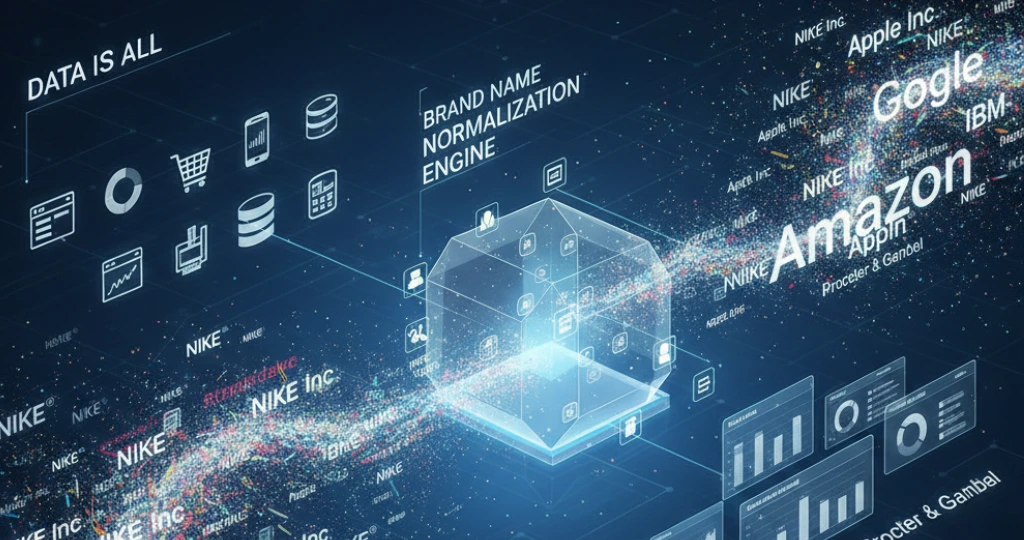
In the present digital business world, information is all. Companies collect data from websites, mobile applications, CRM systems, e-commerce platforms, ad management systems, analytics reports, accounting applications, and numerous other sources. All these systems store brand names at some point. This is exactly where Brand Name Normalization Rules become essential, ensuring that every brand is recorded consistently and standardized across all platforms.
The problem starts when the same brand appears in different formats.
For example, one system may store a brand as “Nike,” another as “NIKE Inc.,” another as “nike,” and another as “Nike®.” Technically, these all refer to the same company. But computers treat them as different entries. This leads to broken reports, incorrect dashboards, and confusion across teams.
This guide will explain the brand name normalization rules, why they are important, how to create them, how to apply them, what mistakes to avoid, and what future trends enterprises need to prepare for.
What Are Brand Name Normalization Rules?
Brand name normalization Rules are designed to be consistent methods for writing, storing, and representing brand names across different systems.
Put simply, when it is the same brand, it is checked in the same manner everywhere.
Suppose there are 10 versions of a brand in your database, and they are being normalized to a single official version. Such a legitimate version is referred to as a canonical name or approved name.
The primary aim of these regulations is to provide uniformity. Consistent data proves to be reliable. By making reliable decisions, businesses can make better ones.
Why Brand Names Become Inconsistent
It is necessary to comprehend the causes of inconsistency first, then develop powerful rules of brand name normalization.
Human behavior is one reason. Once brand names are keyed in manually, each employee can type them differently. Others use capital letters, others use small letters, others have legal abbreviations of their organizations, such as Inc., Ltd, etc., while others forget their punctuation marks. Minor typing mistakes gradually become huge data issues.
The other cause is that of system limitations. The old software systems might not accept special characters. Some systems automatically capitalize the text. Other people may strip out accents or symbols. Such technical disparities cause differences that are not noticeable.
Inconsistency is also associated with marketing practices. A brand may have slight variations in naming styles across campaigns, social media postings, and product packaging. Such fluctuations accumulate in internal systems over time.
There is one more complication of international business. Brand names can be translated into the native languages. Accents may be removed. Spelling can vary depending on regional norms.
Even more confusion is caused by mergers and acquisitions. In a merger, integrating the two brand databases is required. Old brand names still survive alongside new brands. Data is fragmented and lacks explicit normalization rules.
Why Brand Name Normalization Rules Matter
This is because several companies believe that brand naming is not a big technical issue. In practice, they touch almost all departments.
Impact on Reporting and Analytics
When the brand names differ, the sales reports will be inaccurate. Imagine a revenue by brand dashboard. When a single brand is available in five different forms, revenue will be split into five smaller figures. Or the performance of the management can be poorly perceived as weak, yet it can be strong.
Analytic tools also rely on placing data in the right groupings. Comparisons can not be made without normalization. The forecasting models are also disadvantageous because they require clean historical data.
Impact on SEO and Online Visibility
Search engines make use of signals of consistency to interpret brand identity. If your web page, product listing, and structured data use different brand formats, the search engine might treat them as distinct.
Good rules for brand name normalization help establish uniform digital cues. This gives brand power and enhances online visibility.
Impact on Customer Experience
Customers demand the same thing. When one brand name is displayed on your website, and another is invoiced or emailed, it is confusing. Minor doubts will decrease trust.
Issue uniformity renders a business professional. Lack of consistent naming makes the systems look unorganized.
Impact on Legal and Compliance
There will be legal risks in regulated industries when brand names are misused. Financial statements, compliance reports, and contracts necessitate proper brand depiction. Normalization rules help decouple the operational naming requirements from the legal naming requirements.
The True Objective
The goal is not just formatting text correctly.
The deeper objective is to build a reliable data foundation.
When brand names are standardized, businesses can:
- Aggregate data correctly
- Automate workflows safely
- Improve reporting confidence
- Reduce manual correction effort.
- Scale operations efficiently
Brand name normalization rules create a single source of truth. Without a single source of truth, departments operate with different versions of reality.
Core Components of an Effective Brand Name
To design a proper brand name, businesses must focus on several important components.
Defining a Canonical Brand Name
Every brand must have one approved version. This is the canonical name. All variations must map to this single format.
Brand managers or legal teams should approve the canonical name to avoid internal conflicts.
1. Standardizing Capitalization
One of the simplest yet crucial normalization rules is standardizing capitalization. Many brands are often written in all caps or lowercase, but it’s vital to choose one consistent form.
Example:
- Nike (title case) vs. NIKE (uppercase)
- Coca-Cola (with hyphen) vs. Coca Cola (no hyphen)
Decide on the format (e.g., title case, sentence case) and apply it consistently across all platforms.
2. Removing Legal Suffixes
Legal suffixes such as Inc., LLC, and Ltd. should generally be removed from brand names in non-legal contexts, including marketing materials, product listings, and social media profiles. These suffixes often do not add value and create unnecessary variation.
Example:
- Nike Inc. becomes Nike
- Apple Inc. becomes Apple.
However, legal suffixes should be retained in legal contexts, such as contracts and trademark filings.
3. Handling Abbreviations and Acronyms
Abbreviations or acronyms can often confuse systems. It’s essential to decide whether to use the full form or the abbreviation, but not both in different places.
Example:
- IBM (acronym) vs. International Business Machines (full form)
- P&G vs. Procter & Gamble
Choose the preferred form and ensure it’s used consistently.
4. Normalizing Punctuation and Special Characters
Normalization rules should specify how to handle special characters like ampersands (&), hyphens (-), apostrophes (”), and accented characters.
Example:
- H&M vs. H and M (should standardize to H&M)
- Macy’s vs. Macys (standardize to Macy’s)
Consistency in punctuation and special characters is essential for uniformity across systems.
5. Managing Regional Variations
Global companies often face challenges managing multiple brand names across regions or languages. While it’s crucial to respect regional variations, a consistent global brand identity should be maintained.
Example:
- Coca-Cola in the U.S. vs. Coca-Cola in some regions
- Unilever in English vs. Unilever S.A. in some European countries
The goal is to maintain a consistent canonical name, with regional names mapped to it.
Implementation Strategy
An introduction of brand name rules does not just presuppose an introduction of some basic spelling mistakes correction in a database. It is an IT-based governance program that will provide consistency, accuracy, and reliability across all business systems.
Otherwise, the same brand can take on various notes, leading to disjointed reporting, inaccurate dashboards, and incorrect business decisions. The specifics of each implementation stage are described below, along with practical examples that explain how the process works in a real business setting.
1. Conducting a Comprehensive Data Audit
Auditing of the current brand data is the most important and first step in applying the brand name rules. This entails extracting all unique brand names from every system where brand information is stored. Organizations have databases across departments, including sales, marketing, finance, procurement, and e-commerce. The same brand will therefore come out in different systems.
For example, a global brand like Nike may appear in a company’s database as:
- Nike
- NIKE
- Nike Inc.
- Nike, Inc
- NIKE USA
Although these are entries from the same brand, reporting systems can assume they are independent. Businesses should calculate the effect of all such variations and determine them during an audit.
For example, when Nike sales are recorded annually and divided into five name formats, the reports would record revenue less the sum of the names formed, which would create confusion and incorrect analysis. The audit stage helps measure the extent of inconsistency and provides a strong argument in support of normalization.
2. Creating a Master Brand List (Single Source of Truth)
Identifying inconsistencies should be followed by developing a master brand list. The list is used as official reference material containing accepted canonical brand names. An example: This is called a canonical name, and all variations would map to this name.
For example, consider Apple Inc. In different systems, it might appear as:
- Apple
- Apple Inc
- Apple Incorporated
- APPLE INC.
- Apple Computer
The business should designate a single official form in the master brand list: Apple Inc. Every other form will be reduced to this generic name. Other metadata, including the internal brand ID, country, or category, should also be included in the master list. This provides uniformity of analytics platforms, CRM systems, and financial reports.
Notably, the master list must be validated by the relevant stakeholders, including the legal, branding, and compliance teams. This prevents future conflicts when other departments use alternative naming conventions.
3. Mapping Variations to Canonical Names
After the master list is completed, the next task is to map all observed variations to their canonical names. This is normally done through a mapping table. The mapping table serves as a translation layer, converting unreliable inputs into standard outputs.
For example, suppose your system contains multiple variations of Coca-Cola:
- Coca Cola
- Coca-Cola Co.
- COCA COLA COMPANY
- Coca-Cola Company
All these entries should map to a single canonical format, such as “Coca-Cola Company.”
This, however, needs to be done with caution. Certain brands can look alike, yet they are different companies. For example, one should not combine two such companies, “ABC Electronics” and “ABC clothing”, into a single company called “ABC”, which shares a common prefix. Being over-normalized is just as harmful as under-normalization. As such, mapping should be tested and checked.
4. Documenting the Normalization Rules
Long-term success cannot be achieved without adequate documentation. Brand name normalization rules should be formally written and accessible across the organization. Capitalization (e.g., title case), punctuation, abbreviation policy and the treatment of legal suffixes (e.g.,. Inc. or LLC) should be defined as before.
As an example of this, say in your policy it is a requirement that legal suffixes be always added, then records such as “Microsoft” should be normalized to “Microsoft Corporation”. Conversely, if the organization decides to keep legal suffixes out of the way, then the names “Microsoft Corporation” and “Microsoft Corp” would all be normalized to “Microsoft”.
New employees and data teams will be able to adhere to the same standards because the rules are well-documented, ensuring no inconsistencies in the future.
5. Integrating Rules into Business Systems
Normalization should not be considered a cleanup operation. Unless rules are woven into active systems, inconsistency will soon recur. As such, normalization logic needs to be incorporated into data pipelines, CRM applications, ERP, and data imports.
For example, when a sales representative manually enters a query term (Amazon) into a sales system, it should be automatically standardized to Amazon by normalization rules. Free-text errors can be minimized by using dropdown lists and validation controls.
Likewise, when importing third-party data, the system must automatically pass the brand names through the mapping table before saving them to the database. This guarantees that the future information is clean and in line with the list of master brands.
6. Testing and Validation Before Full Rollout
Before fully deploying brand-name normalization rules, businesses must test the impact. This will entail creating reports before and after normalization, as well as comparing key measurements, including revenue amounts, brand numbers, and performance scorecards.
For example, Samsung Electronics might have presented itself in four different formats in the previous system. Upon normalization, these four entries would then be consolidated into a single entry. The total revenue will remain the same; however, the brand-level reporting will now reflect true unified figures.
A cross-departmental review should be conducted during testing to ensure that no legitimate brands were mistakenly merged and that no data were lost during the transformation.
7. Continuous Monitoring and Maintenance
Normalization of brand names is not a simple undertaking; it is a continuous governance process. Businesses should conduct regular audits to identify new variations that may have entered the system. Moreover, during brand rebranding, mergers, and company takeovers, the master brand list should be revised.
For example, when an official amendment to a brand name occurs, the normalization rules need to account for it at that point to ensure that stale entries do not appear in the end report. Long-term data accuracy and analytics system protection are ensured through constant monitoring.
Manual Versus Automated Normalization
Manual normalization is efficient with small datasets but ineffective with large datasets. It involves a human check and amendment, which takes time and poses a risk of error. Rule-based scripts or data quality tools are used for automated normalization. More sophisticated systems can automatically identify new variations using machine learning.
Nevertheless, the implementation of automation should be checked. Coincidental mapping may combine different brands. The automated environments still require human control.
Challenges in Implementing Brand Name Normalization
Although brand name normalization has some obvious advantages, it is not easily implemented and maintained:
1. Data Entry Errors
The manual data entry is usually a major contributor to brand name variation. Despite any set of rules, human errors, such as spelling or typing mistakes, can lead to data discrepancies.
2. Legacy Data Issues
The brand name data in older systems and databases is usually inconsistent. Historical data might be time-consuming and laborious to clean and normalize.
3. Global and Regional Variations
Foreign markets do not have to use the same format, language, or character set. Certainly, it may be hard to handle these regional variations while remaining global.
4. Mergers and Acquisitions
When it comes to mergers/acquisitions, there might be two distinct brand names within the legacy systems, making it hard to unify them into a single brand.
Over-Normalization and Its Risks
Over-normalization is a significant problem rarely discussed.
When the rules are excessive, separate brands can be wrongly combined. For example, two brands with similar underlying words could be grouped.
This leads to distorted reporting, which can take months to be noticed.
Strong brand name normalization rules must balance precision and caution. It is preferable to ensure cases are correct by reviewing them manually rather than merging the wrong ones.
Governance and Ownership
Without governance, normalization is impossible.
There must be a clearly defined owner of the brand name normalization rules. This can be a data governance team, a brand management department, or a cross-functional committee.
It should also have a formal process for change requests. The introduction or rebranding of new brands involves updates and the appropriate approval steps.
Consistent reviews are pertinent. Markets evolve. Companies merge. New systems are introduced. Rules must adapt over time.
Measuring the Success of Brand Name Normalization
Success should not be assumed. It should be measured.
Businesses can track:
- Reduction in duplicate brand records
- Improved reporting consistency
- Faster dashboard creation
- Decrease in manual corrections
If analysts spend less time fixing brand issues and more time analyzing trends, normalization is working.
Brand Name Normalization Rules in a Global Context
Multinational corporations have their own difficulties.
Local translations/spelling Brand names can be translated locally or spelled out. Presentation may be subject to cultural differences. An active normalization frame provides a single global canonical name and, when necessary, localized display names.
The same should be reflected in the backend systems, where even though the front-end displays may differ, the systems must remain globally consistent.
Brand Name Normalization Across Industries
1. E-commerce
In e-commerce, unified brand names ensure products are placed in the right category and that customers find what they want with ease. The same product may be displayed more than once with varying brand names without normalization, confusing customers and deterring sales.
2. Marketing and Advertising
Clean data is important to advertising campaigns to track their performance. Normalized brand names ensure that campaign results are attributed to the relevant brand, enabling ROI analysis.
3. Data Management and Analytics
Analytics tools rely on consistent data to present accurate insights. By normalizing brand names, a business can ensure that all data points about a brand are properly aggregated, improving decision-making.
Future of Normalization Rules
As data ecosystems grow, normalization will become increasingly essential.
Artificial intelligence systems require clean training data. Machine learning models are likely to be misled by an inconsistent brand name. Clean brand data helps improve the quality of automation.
Data normalization will be performed more often when it is entered in real time. Varying systems will automatically correct variations before they enter databases.
Conclusion
Despite technological progress, a clearly defined human-created brand name will remain the foundation.
Brand name normalization rules are not just technical guidelines. They are strategic tools that preserve the accuracy of the data, enhance brand identity, reinforce reporting and enable the expansion of the business in the long run.
Data is highly fragmented and unreliable without normalization. Reports become misleading. Teams consume time with mistakes. Customers observe inconsistency.
With strong brand name normalization rules, businesses gain clarity, efficiency, and confidence.
The power of consistency is in a data-driven world. Companies investing in clear, systemic normalization frameworks establish a firmer digital foundation and position themselves for scalable, reliable expansion.
Frequently Asked Questions
1. What is brand name normalization?
The process of standardizing a brand name to provide a consistent image across all platforms and systems is known as brand name normalization, which eradicates variation in capitalization for abbreviations or legal suffixes.
2. Why is brand name normalization important for SEO?
Normalization helps consolidate search signals about a brand, making it easier for the search engine to index and rank. This enhances the visibility of online activities and improves SEO performance.
3. Can I manually normalize brand names?
Although one can manually normalize, the process is time-consuming and error-prone. To ensure the program is free of human error, one should automate the process using data management tools.
4. How often should brand-name normalization rules be reviewed?
Brand name normalization rules should be reviewed regularly, especially after rebranding, mergers, or system updates. It is suggested that quarterly reviews be done.
5. What happens if two brands have similar names?
There needs to be strong governance to avoid confusion. Changes to similar brands should be approved by both the legal and brand management teams as a precaution to prevent mistakes that could result in inaccurate changes.