
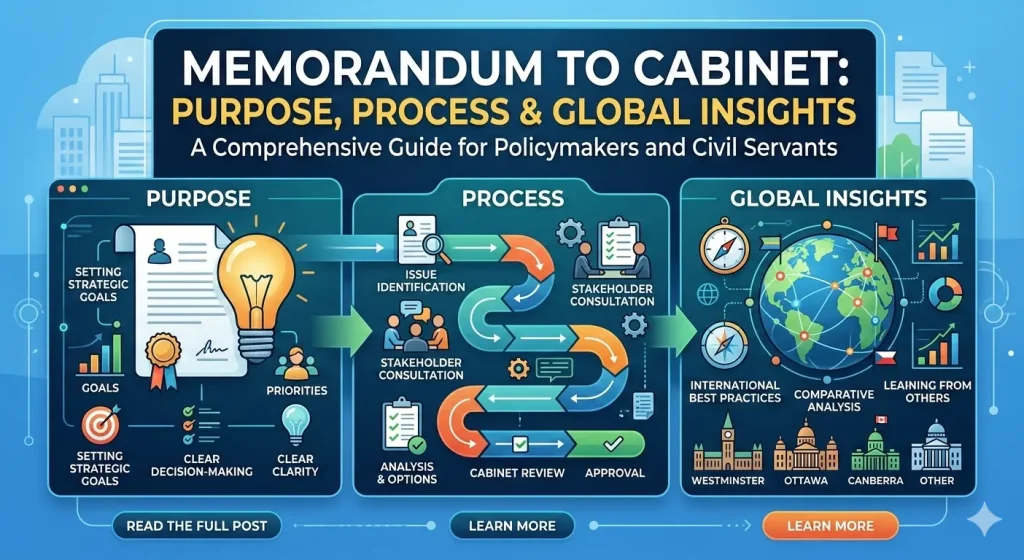
A memorandum to cabinet is one of the most important instruments in executive government. It is the official letter by which a minister asks the Cabinet to endorse, in one voice, important policy, legislative, financial, or strategic decisions.
Although rarely visible to the public, the memorandum to cabinet sits at the heart of how governments transform ideas into authorized action. Since national healthcare reforms and infrastructure investments, most major public initiatives start as well-designed Cabinet submissions.
This guide provides a comprehensive, globally informed explanation of the memorandum to the cabinet — covering its purpose, structure, drafting methodology, approval lifecycle, and its role across Westminster and presidential systems.
What Is a Memorandum to Cabinet?
A memorandum to cabinet (often shortened to MC) is a confidential policy submission prepared by a government department and sponsored by a minister. Its core purpose is to request a formal Cabinet decision.
At its simplest, every memorandum to the cabinet answers three essential questions:
- What issue requires Cabinet attention?
- What options are available?
- What course of action is being recommended?
In Westminster systems such as Canada, Australia, and the United Kingdom, the memorandum to the cabinet is a formal mechanism for collective executive decision-making. Conversely, in the United States, Cabinet memoranda are present. Still, they are not run like those in a presidential system led by a President rather than by the collective will of a Cabinet.
Understanding these structural differences is essential to understanding the Memorandum to Cabinet’s globally.
Constitutional and Governance Foundations
1. Westminster Systems
In Westminster parliamentary democracies:
- Cabinet operates under collective responsibility.
- Decisions are made jointly.
- Ministers must publicly support Cabinet decisions once approved.
The memorandum to the cabinet is the procedural vehicle that enables this collective model. It ensures:
- Coordination across departments
- Alignment with government priorities
- Formal authorization before action
Without an approved this, departments generally lack authority to proceed with major policy or spending initiatives.
2. Presidential Systems
In presidential systems like the United States:
- The President holds executive authority.
- Cabinet members are advisors.
- Memoranda to Cabinet are briefing or directive tools rather than formal mechanisms for collective approval.
As an example, Gerald Ford issued a memorandum to his Cabinet on September 16, 1975, that contained the agenda items to be discussed. Although the power, such memoranda did not serve to empower collective decision making as Westminster MCs.
Thus, globally, the memorandum to Cabinet varies in legal weight — but in parliamentary systems, it is central to executive legitimacy.
Why Memoranda to Cabinet Matter ?
A memorandum to Cabinet is the gateway to high-level government action. It matters because it:
- Authorizes major public spending
- Initiates legislation
- Reshapes national programs
- Coordinates multi-departmental initiatives
- Responds to emerging crises
The quality of a memorandum to cabinet directly affects the quality of Cabinet decisions. Weak analysis can lead to flawed policy. Strong analysis strengthens governance outcomes.
When Is a Memorandum to Cabinet Required?
Although procedures vary by jurisdiction, an MC is generally required when a proposal:
- Launches a new public policy or initiative
- Significantly changes an existing program
- Requires new funding or reallocates budgets
- Introduces or amends legislation
- Impacts multiple departments
- Responds to Cabinet direction
In many governments, no major initiative proceeds without an approved memorandum to cabinet.
Core Structure of a Memorandum to Cabinet
While templates differ, most memoranda to cabinet include the following components:
1. Ministerial Recommendation (MR)
The Ministerial Recommendation is the most critical section. It clearly states:
- The issue
- The recommended option
- The approvals being sought
This section is often concise and written in directive language:
“It is recommended that Cabinet approve…”
Cabinet members frequently focus heavily on this section due to time constraints.
-
Background and Context
This section explains:
- How the issue emerged
- Previous decisions
- Policy gaps
- External pressures
Its goal is to answer: Why is Cabinet attention required now?
-
Policy Options and Analysis
A strong memorandum to cabinet typically presents:
- A recommended option
- Two alternative options
Each option should outline:
- Advantages
- Disadvantages
- Costs
- Risks
- Alignment with government priorities
This comparative structure demonstrates that alternatives were considered seriously.
-
Financial Implications
Cabinet decisions often carry fiscal consequences. This section explains:
- Short-term costs
- Long-term budget impacts
- Funding sources
- Assumptions
Clear costing builds credibility.
-
Legal Considerations
Where legislation or regulatory changes are required, the MC outlines:
- Legal authority
- Required amendments
- Constitutional considerations
-
Mandatory Impact Assessments
Depending on jurisdiction, memoranda to cabinet may require:
- Gender-based analysis
- Environmental impact review
- Indigenous consultation considerations
- Regional implications
- Official language obligations
These assessments reinforce responsible governance.
-
Implementation Plan (Annex)
The Implementation Plan details:
- Timelines
- Milestones
- Responsible departments
- Performance measurement
It demonstrates feasibility.
-
Communications Strategy (Annex)
Because Cabinet decisions affect citizens, communications planning includes:
- Key messages
- Stakeholder outreach
- Media strategy
- Timing
This ensures coordinated public messaging.
5 Key Steps in the Memorandum to Cabinet Approval Process
Step 1: Drafting and Consultation.
The process begins with the sponsoring department preparing the memorandum to cabinet (MC). It is the first draft that will provide the plan, goals, justification, and expected results. Interdepartmental consultation is important to this stage. The sponsoring department liaises with other departments and agencies that are affected to ensure that all possible effects that may arise, including financial, operational, legal, social, or environmental, are clearly identified. Such consultations can be done in several phases of modification to define duties, evaluate resource consequences, and resolve issues. An efficient planning draft is highly likely to facilitate subsequent steps in the review process.
Step 2: Central Agency Review
When the draft MC is prepared, it is presented to the central agencies (usually the Treasury, Cabinet Office, or similar oversight agencies) for review. In Westminster-type governments, central agencies play a challenge role, critically scrutinizing the memorandum for quality and alignment. They would evaluate the proposed initiative’s compliance with overall government priorities, the financial and risk analyses, and the consideration of potential indirect outcomes. The feedback from the central agencies may result in significant changes to the argument to address risks or to modify the policy strategy before submission to the Cabinet.
Step 3: Review of Cabinet Committee.
A dedicated cabinet committee frequently discusses the memorandum before it is sent to the entire Cabinet, e.g. a committee on economic, social policy or national security matters. These committees provide a forum for a narrow technical debate among ministers with subject-matter expertise. The committee discusses the proposal line by line, with reference to its merits, costs, risks, and alternatives. They can demand additional evidence, amendments, or referral to the other stakeholders. This measure is taken to ensure that all technical and interdepartmental problems are resolved before the MC attains full Cabinet status.
Step 4: Full Cabinet Decision
The full Cabinet then considers the memorandum. Cabinet deliberations are collective, meaning ministers discuss, negotiate, and aim for consensus on the recommended course of action. Possible outcomes of this stage include:
- Approval: The proposal is accepted as submitted, allowing immediate implementation.
- Modification: Cabinet requests changes to objectives, funding, or timelines before approval.
- Rejection: The proposal is not accepted, and departments are directed to halt or revise the plan.
- Deferral: Cabinet may delay the decision to seek additional information or consult further stakeholders.
Decisions at this stage are formally recorded, but the discussion process itself is often confidential to maintain ministerial solidarity and trust.
Step 5: Record of Decision
After Cabinet approval, a formal Record of Decision (RoD) is released. The document is the formal permission for departments to implement, and the responsibilities and agreed actions between the units are outlined, along with any conditions or alterations required by the Cabinet. The RoD will now serve as the primary point of reference for accountability, and all departments will be made aware of their roles and the allowed course of action. It also provides the history of the evaluation for future use in audits and reviews of policies.
Confidentiality and Cabinet Confidence
Memoranda to Cabinet (MCs) are strictly protected under Cabinet confidence rules, a cornerstone of Westminster-style governance. These rules ensure that sensitive discussions and deliberations remain confidential, fostering an environment where ministers and officials can engage openly and frankly. Key purposes of this confidentiality include:
- Candid Debate: Ministers can freely express concerns, challenge assumptions, and explore alternative approaches without fear of public scrutiny or political repercussions. This openness improves the quality of decision-making.
- Protection of Sensitive Information: Cabinet discussions often involve classified data, commercial negotiations, national security matters, or other sensitive content. Confidentiality safeguards this information from premature disclosure.
- Freedom to Challenge Proposals: Ministers can critically assess and question recommendations from departments or peers without the constraints of external pressure or media exposure, thereby promoting robust well-considered policies.
At the same time, confidentiality does not remove accountability. Once Cabinet decisions are implemented, governments remain responsible to parliaments, legislatures, and the public. Transparency mechanisms, such as reporting, audits, and parliamentary scrutiny, ensure that decisions are made responsibly while preserving the integrity of the Cabinet’s deliberative process.
Memorandum to Cabinet vs Other Government Documents
| Document | Purpose | Decision Authority |
| Memorandum to Cabinet | Seeks formal collective approval | Cabinet |
| Briefing Note | Informs a Minister | Minister |
| Discussion Paper | Explores ideas | None |
| Cabinet Minutes | Records decisions | None |
The memorandum to the cabinet is unique because it requests binding executive authorization.
Common Drafting Mistakes
Even experienced officials can make errors when preparing a memorandum to the cabinet. Common issues include:
- Overly technical language
- Lack of a clear recommendation
- Weak risk analysis
- Incomplete costing
- Insufficient stakeholder consideration
- Failure to align with government priorities
Strong MC drafting balances precision with clarity.
What happens if the Cabinet rejects an MC?
If rejected:
- The proposal may be revised and resubmitted
- Departments may be directed to conduct further analysis
- The initiative may be abandoned
Rejection is not uncommon, particularly when fiscal pressures or political sensitivities are present.
Real-World Impact of Memoranda to Cabinet
Although confidential, memoranda to the cabinet shape policies affecting:
- Healthcare access
- Infrastructure development
- Education reform
- Climate initiatives
- National security
- Fiscal policy
Major reforms often begin as carefully prepared MCs before becoming public announcements.
Why the Memorandum to Cabinet Remains Essential
Despite advances in digital governance and analytics, the memorandum to the cabinet remains indispensable because it:
- Structures complex information
- Forces comparative analysis
- Encourages risk transparency
- Reinforces collective responsibility
- Aligns departments around shared objectives
It prevents impulsive governance by requiring disciplined preparation.
Frequently Asked Questions
-
What is a Memorandum to Cabinet (MC)?
A Memorandum to Cabinet is a formal document submitted by a government department or agency to request collective Cabinet approval for major policies, programs, legislation, or funding decisions. It explains the proposal, impacts, risks, and expected outcomes.
-
Why is Cabinet confidentiality important for MCs?
Cabinet confidentiality ensures that ministers can debate candidly, challenge proposals without external pressure, and protect sensitive information such as national security, financial data, or interdepartmental negotiations.
-
Is a Memorandum to Cabinet legally binding?
An MC itself is not binding until the Cabinet approves it. Once approved, the Record of Decision formalizes the authorization, making the proposal actionable for government departments.
-
Are Memoranda to Cabinet publicly available?
Typically, no. They are protected under Cabinet confidence rules. However, summaries or decisions resulting from an MC may be made public after approval, especially in parliamentary oversight or transparency reports.
-
How long does a typical MC take to process?
The timeline varies depending on complexity. Drafting, consultation, central agency review, committee discussions, and full Cabinet approval can take weeks to months, especially for major policy proposals.
-
What countries use Memoranda to Cabinet?
MCs are standard in Westminster-style parliamentary systems, including the UK, Canada, Australia, and New Zealand. Other systems, like presidential governments, use equivalent documents (e.g., executive proposals) but with different legal roles.
-
What are the key components of a Memorandum to Cabinet?
A well-prepared MC usually includes:
- Policy or program objectives
- Options and recommended approach
- Financial and operational implications
- Risk analysis
- Consultation details and stakeholder impact
- Implementation and communication plans
-
Can an MC be modified after submission?
Yes. During central agency review or cabinet committee scrutiny, proposals can be revised to address feedback, clarify risks, or improve alignment with government priorities before final Cabinet consideration.
-
How is the decision communicated to departments?
Once the Cabinet approves an MC, a Record of Decision (RoD) is issued. This document is the official authorization for departments to proceed and outlines the approved course of action and responsibilities.
Final Perspective: A Cornerstone of Executive Governance
The memorandum to the cabinet is more than an administrative requirement. It is the structured pathway through which governments convert ideas into authorized national action.
Across Westminster democracies and beyond, it ensures that decisions are:
- Informed
- Coordinated
- Strategically aligned
- Financially responsible
- Politically accountable
Understanding the memorandum to the cabinet provides rare insight into how executive power is exercised responsibly behind the scenes. It is one of the central pillars of modern governance.