
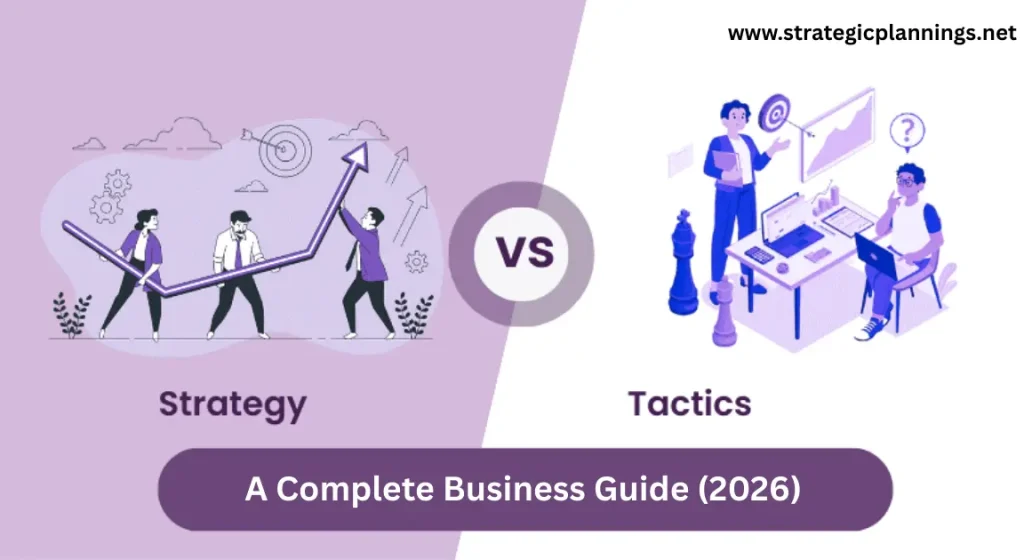
The strategy vs Tactics is one of the debates that are recurring in modern organizations. These words are used drastically by leaders, managers and teams, and most people find it hard to define the difference. This confusion brings about misalignment, feeble performance and disappointment on accomplishment of hard work that does not bear significant outcomes.
Fast, competitive, digitally connected markets of the 2026 businesses are where businesses operate. Clear thinking is essential. The knowledge of Strategy vs Tactics assists organizations in determining the course of action, focusing on work and translating vision into a measurable success. Using simple English, clear headings, and real business logic, everything is done in a step-by-step mode as explained in this guide. Every idea is expounded to the end to make sure that everything does not seem like a hurry.
Why Strategy vs Tactics Is Still a Big Business Problem
Nevertheless, strategy and tactics are still confused by various organizations though it has been discussed over the years. One of the reasons is the fact that both terms are applied informally during the meetings and planning papers. Teams usually refer to projects, tools, or campaigns as strategy when they are strategic tactics.
The other cause is the stress of delivering fast. Tactics involve immediate action, whereas strategy entails thinking, patience and alignment. Consequently, the organizations become action-oriented before settling on direction. Long term, this translates to teams that are busy, efforts that are disjointed and poor performance.
Knowledge is an eye opener, saves time and money that goes into futile effort, and makes better decisions within the company.
What Strategy Really Means in Business
Strategy as Long-Term Direction
Strategy entails the long-term plan of an organization. It establishes the place where the business is heading and the reason why this is so. Strategy is an outlook that looks into future positioning and goes beyond daily operations.
The business strategy typically covers three to five years and takes into account the market trends, needs of customers, competition and internal business strength.
Strategy as a Set of Choices
Strategy is not a wish list. It is an arrangement of conscious decisions. The decisions will assist leaders in making a decision on what the organization focuses on and what it does not. All powerful strategies have trade-offs.
As an illustration, an organization can opt to compete based on quality as opposed to price. This choice influences the investments, employment, and the experience of the customers.
Strategy as a Decision-Making Guide
Intense strategy serves as a sieve. The leaders will be able to speedily assess the conformity of new ideas or challenges to strategic goals when they occur. This avoids distraction, hence getting the organization in line.
What Are Tactics and How They Work
Tactics as Short-Term Actions
The concrete steps undertaken to pull the organization to its strategy are tactics. They are action-oriented and not direction-oriented.
Tactics are generally of the short term, week, month, or even one year. They are realistic, quantifiable and adaptable.
Tactics Turn Plans Into Reality
Whereas strategy explains what success appears like, tactics are described to explain how to bring success about. They involve initiatives, projects, operations and campaigns.
The concept of strategy is theoretical without tactics. Strategies are worthless without tactics in them.
Strategy vs Tactics: The Core Differences Explained
Difference in Purpose
Strategy is meant to be the way forward and success. Tactics are meant to implement and provide short-term results.
Difference in Time Horizon
Strategy looks years ahead. Tactics concern the immediate and the short-term. This contrast is the reason why strategy is kept constant, though tactics are subject to change depending on the conditions.
Difference in Ownership
Leadership is generally a holder of strategy. Managers and work teams possess tactics and carry out the work.
These differences will enable organizations to prevent a combination of roles and responsibilities.
Strategy vs Tactics Through a Simple Analogy
See strategy as a point on the map. The steps are the steps dealt with along the road.
The destination is not changing every day, but the path is. Traffic, weather or road blockages might necessitate revisions. Equally, companies adapt strategies even though they remain true to their strategy.
This comparison simplifies the implementation and comprehension of Strategy vs Tactics.
Why Strategy Should Always Come First
Strategy Creates Alignment
With the definition of strategy, every team knows in which direction they are going. This coordination minimizes departmental conflict and confusion.
Strategy Prevents Wasted Effort
Lack of strategy could mean that the team’s hard work on activities is not helping the long-term goals. Strategy makes the resources be used wisely.
Strategy Enables Better Tactics
Effective design of tactics is facilitated by a clear strategy. Teams are aware of what results are essential and are free to make decisions that will bring those results.
This is the reason why one should always present a strategy before tactics.
What Makes a Strong and Effective Strategy
Clear Long-Term Goals
A good strategy places clear goals that identify what success will be in the future. These are to be reasonable and attainable objectives.
Well-Defined Objectives
Goals consist of objectives that are divided into specific outcomes. They elaborate on what should be changed or better to accomplish the strategy.
Measurable Indicators
Good plans have an approach to measure improvement. These indicators are used to determine the success of the strategy among the leaders.
Organizational Alignment
A strategy must be known in the organization. Information within other departments enhances coordination and dedication.
Outcomes vs Activities: A Critical Strategic Distinction
Among the most widespread strategic errors is the inability to differentiate between the activities and results.
Activities are about the activities of teams. Outcomes explain the change in what.
Powerful action plans are team result-oriented. This allows flexibility in a team to make the most appropriate decisions and remain consistent with strategic intent.
This differentiation is necessary in the Strategy vs Tactics.
What Defines a Good Business Tactic
Clear Purpose
Any of the tactics must have a clear objective that is based on strategy. The strategy might not be needed in case the relationship is ambiguous.
Defined Timeline
The tactics ought to possess an origin and a destination. This brings a sense of urgency and responsibility.
Measurable Results
In a good tactic, there should be a definite standard of success. This will enable teams to be performance conditioned and learn outcomes.
Assigned Ownership
There should be an accountable owner of each tactic. Ownership grants responsibility and follow-through.
How Detailed Should Tactics Be?
The degree of thoroughness is relative.
Risky or controlled operations need accurate and documented strategies. Such innovative or exploratory projects are good at adaptability.
This is aimed at offering a sufficient framework so as to inform action but not constrain adaptation.
Think Strategically, Act Tactically
One principle helpful in the role of a leader is to think strategically and act tactually.
This implies that one should have a long-term vision in mind when carrying out short-term functions. The teams, which adhere to this principle, do not become inflexible.
Such an attitude reinforces the bond between the strategy and implementation.
Strategy vs Tactics Across Different Sectors
Public Organizations
Typically, the public organizations concentrate on trust, accountability, and the quality of the services. Long-term enhancement in transparency or communal faith may be strategic. Strategies can be communication programs, online platforms, and programs of engagement.
Annual plans typically include strategies, whereas multi-year plans stipulate strategy.
Education
Strategy in education can be directed towards better learning or engagement. Some of these tactics can include the teaching tools, professional development, or curriculum improvements.
All the tactics are corroborative of the strategy, enhancing the way students learn and engage with the content.
Healthcare and Services
Healthcare organizations are faced with issues concerning capacity, efficiency and quality. Strategy can be directed towards the enhancement of patient flow or the experience of service delivery. The tactics can consist of the planning of improvements, optimization of the process or other service-delivery approaches.
These strategies help the realization of long term objectives without any modification of the strategy.
Strategy vs Tactics in Marketing
Marketing is a good illustration of mix up between strategy and tactics.
Audience, positioning, and value proposition are determined by marketing strategy. The marketing strategies involve campaigns, content, and avenues to the customers.
Placing an advertisement or posting material is not a strategy. The actions only work when it is matched with a definite marketing approach.
Strategy vs Tactics in Leadership and Management
The task of setting a strategy is on the leaders. The managers are tasked with implementing tactics.
Effective leadership would mean that the strategy is well communicated. Good management will result in tactics being implemented.
The absence of this balance means that organizations will not easily translate plans into results.
How to Measure Strategy Effectively
The meaning of measuring strategy is on long-term results as opposed to day-to-day activity.
Strategic measurement is measuring trends, working towards objectives and performance. Such measures assist leaders in knowing whether or not the strategy is still appropriate and still effective.
Goals must be achievable and divided into achievable deadlines.
How to Measure and Control Tactics
Tactics have to be monitored with more attentiveness since it entails implementation.
Proper tactical measurement entails schedule, milestones, resource monitoring and accountability. Reviews allow teams to keep on track and make some amendments when necessary.
Reviewing Strategy and Tactics Together
Tactics and strategy are better when considered as a unit.
The best recommended response would be a PR review of strategy less regularly and tactics more frequently. This makes sure that long-term direction is not altered, but at the same time, short-term actions are also efficient.
This is a critical balance for sustainable success.
Common Business Mistakes Related
Organizations often struggle because they:
- Change strategy too frequently
- Treat projects as strategy
- Focus on activity instead of outcomes
- Fail to review progress consistently
Recognizing these mistakes helps businesses improve clarity and execution.
Strategy vs Tactics in the 2026 Business Landscape
By 2026, organizations are going through an accelerated period of technological change, competitiveness and evolving customer demands.
Successful organizations stay strategic without standing still in the face of change. They make decisions using data to drive coordination between teams.
Learning Strategy vs Tactics makes the businesses very competitive in this environment.
Final Conclusion
Learning the Strategy vs Tactics is a prerequisite for every organization who desires to be successful in the long term. Strategy offers direction, purpose and clarity. Tactics bring action, impetus, and outcomes.
Organizations are able to march forward when there is a clear definition of strategy and tactics as well as alignment. Rather than being tactics/ strategy, successful businesses learn to do both and know how they can interrelate.
FAQs
What is the simplest way to explain Strategy vs Tactics?
Strategy is the plan in the long term, whereas tactics are the short-term strategies employed in attaining the plan.
Why is strategy more stable than tactics?
Strategy deals with long-term guideline whereas tactics react to temporary conditions and performance.
Can tactics influence strategy?
Admittedly, strategic changes can be informed by the results of tactics, but they must not substitute strategy.
How often should strategy and tactics be reviewed?
The review of the strategy is typically done quarterly or on a yearly basis, as compared to the tactics, which should be done monthly.
How can small businesses apply Strategy vs Tactics effectively?
Through the maintenance of simplicity, clarity and conciseness of strategy, which is substantiated by focused high-impact tactics.