Empty desks on a long-term basis leak money. When a customer finally goes to checkout and finds that the line isn’t under management, many of them just go away and that transaction doesn’t appear on the report. There is an operational system that uses the term queue management, meaning it solves these problems by capturing walk-in traffic, organizes it and directs each customer to the appropriate associate before they get frustrated. This guide will explore what a retail queue management system is and how it works step by step, highlight the characteristics of relevant features, uncover the shortcomings it addresses and help you select a system that works for a multi-store network.
What Is Retail Queue Management?
Retail Queue Management (RQM) is the art of structuring, making visible and identifiable waiting lines and time. Rather than waiting in a queue and deducing the wait time, the system automatically registers the customer’s arrival, estimates the wait time and assigns the customer to the staff available.
That’s where a dedicated tool really comes in handy. A retail option like Booxi provides platform support for multi-store networks with a retail queue management system, and prevents ‘lost at the door’, by capturing and directing walk-in customers. That allows for a real-time view of who’s waiting to the store teams and provides a single read from HQ at each location.
Comfort isn’t just the objective. Retailers are mimicking the structured flow with access to data a store can operate on, in turn making it a business opportunity and not a business convenience.
How Is a Virtual Queue Different From a Physical Line?
Physical line ensures customers stay lined up and wait their turn. They can join them in a virtual queue, by using a QR code or a screen, and continue browsing while the system awaits their arrival. Since the customer isn’t meant to stand in one place, they stay at or near the store longer, which means they are more open to a sale. The store also receives real-time information on the number of lines and the reason they are waiting, providing an advantage over a physical line.
Why Do Retailers Treat Queue Management as an Operational Lever?
Any spectator who leaves the store due to its wait is a customer that the store already paid to bring in. Queue management can help make that loss apparent and can then be reduced, through the absorption of traffic loads during peak periods. Flow is now measured and enables the headquarters to compare stores, identify potential bottlenecks and staff around the actual demand rather than a guess. Counting traffic is not the important factor, it is controlling traffic that is making queue management an operational priority.
How Does Queue Management Work Step by Step in a Store?
Modern queue management proceeds in a logical order – from the time the customer joins the queue to the time an employee welcomes him. Every step is eliminating a friction that the customer could have given up on at.Every step is designed to avoid the loss of the customer.
How Do Customers Join a Queue Without Standing in Line?
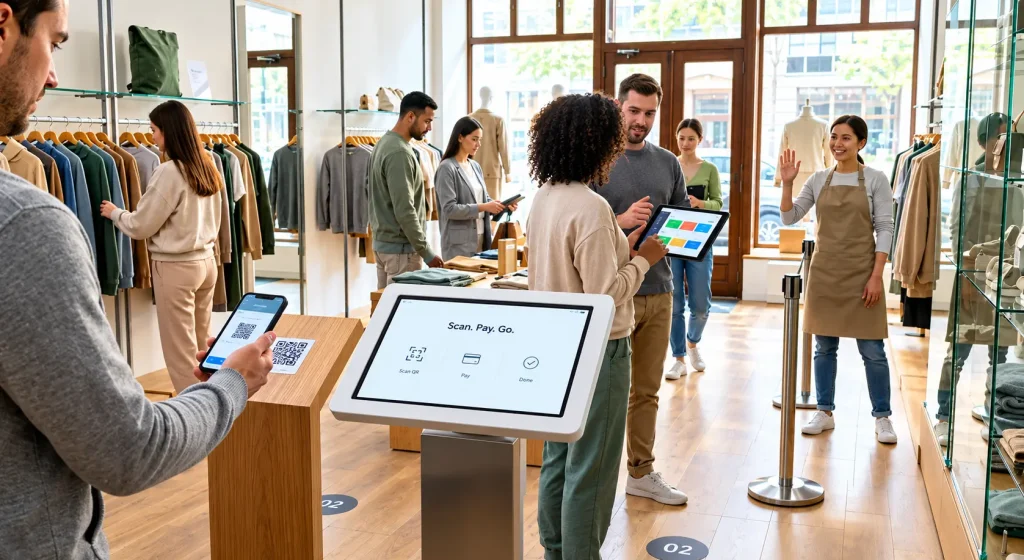
Users register on arrival by scanning a QR code, tapping a link or checking in at a check-in kiosk. This system identifies who they want and what they need and automatically queues them in the proper queue. Those who opt for no lines can wander the show floor or go outside at check-in time which takes no time, even if your purchases add up. This self check-in step turns a congested entryway into a distinctively organized, and tracked, entryway.
How Does the System Estimate and Update Wait Times?
However, once a customer is placed in a queue, the system uses staff availability and services in front of him to compute an estimate for the time he should wait to be serviced. It adjusts that guesswork on the fly as associates complete interactions and demand changes. It gives customers an accurate idea of the wait so that fewer are deterred by some uncertainty. Precise estimates also enable managers to anticipate an impending queue overflow and work around it to prevent it from happening.
How Are Customers Notified and Routed to the Right Staff?
The system automatically informs the customer via text message or the screen that it is prompting him/her to come back when he/she is approaching the front of the line. It then refers them to an associate who fits their needs – either because of a given service or some kind of specialization. As routing is skill-specific, by the first call, a customer will get connected to the person he deserves. That direct handoff speeds up the perceived wait and establishes a better interaction.
What Are the Core Features of a Retail Queue Management System?
Let’s look at the following features and how they distinguish a true queue management system from just a ticket dispenser. The two provide both a customer-side and a staff-side plus a reporting-side view of walk-in flow.
Self Check-In and Virtual Queuing
Self check-in enables the customers to join the line using the QR Code or link without having to interact with staff. It is then that the virtual queuing takes place in order to let them circulate throughout the store. This combination eliminates the visible line at the door and helps to keep customer friendly, not with waiting but with products.
Real-Time Wait Tracking and the Staff Mobile App
Real-time tracking provides store teams with an up-to-the-minute overview of who is waiting, how long they’ve been waiting, and why. This view and its notifications are pushed to associates on the floor by a staff mobile app, as opposed to a back-office screen. Since teams work on the latest data, they can adjust the level of effort any time they start to notice a row forming in the queue.
Why Does a Unified Queue Matter for Appointments, Walk-Ins, and Events?
An establishment doesn’t get just one of these visits. There are no customer types left unmanaged as everything is handled from one single queue to book appointments, make spontaneous booking or host group events in a unified view. All systems are combined, making staff easier to handle because they’re not manually shifting between systems and headquarters are able to view the big picture of demand throughout all stores. That’s how a huge network can maintain their experience at scale.
What Problems Does Queue Management Solve in Retail?
Queue management is what is designed to solve a particular set of expensive recurring retail issues. They are all related to traffic that comes and goes without being captured or metered.
How Does It Reduce Walk-Outs During Peak Hours?
Peak periods are used to get the traffic onto a fixed capacity, and it’s just then customers walk away. Research from Facit.ai 73% of customers leave after 5 minutes, and fast service at the door will help you to secure revenue. Queue management takes the spike by managing the queue and setting proper expectations, and thus is able to hold a customer in the store instead of letting him (or her) go. An invisible walk-out turns into a number a manager will look at and bring down.
How Does It Improve Staff Productivity and Store Flow?
Without structured walk-ins, associates are constantly required to be reactive and time is lost and used only by chance for sales work. Arrivals are queued and routed which means staff understand who is next and what they need, reducing the need for scramble. Same team works more customers; since effort is related with real demand. This also helps to smoothen out the hassle of the peak hour for customers and staff.
How Does It Protect the Experience for High-Value Clients?
Not all of the customers in a shop hold the same value, but a regular line treats it as if they all do. A known highest value client can be recognized and served without being lost in general traffic through queue management, which can implement prioritization. Since automatically identified who’s waiting, associates can customize the greeting—rather than starting cold. That essentially would help to save the relationship and the bigger basket that the client tends to spend.
How Do You Measure the Impact of Queue Management?
The worth of Queue Management is taken into account by way of numbers that a retailer can monitor earlier than and after the roll out. Measurement is the key that makes this an operational fix into a business case, signed by leadership to be funded.
Which Metrics Show Whether Queue Management Is Working?
Average wait time, walk-out rate and percentage of traffic served-on are the best indicators. Retailers also monitor conversion and average basket because booked and structured calls are: Booked visits convert at around 70% compared to less than 20% for walk-in traffic, highlighting the positive influence structure can have on your outcomes, according to Booxi’s Voice of Appointment. Attributing these metrics to each store could help leadership determine which stores are generating profit and which are not.
What Should Retailers Look for When Choosing a Queue Management System?
All systems are not suitable for a large, multi-location retailer. The right selection is a balance between the control that enterprises need and the ease with which store teams can utilize it.
Does It Fit Multi-Location, Enterprise-Scale Operations?
The key with a network of stores is to offer a system that allows headquarters to see the activity of each store, which keeps each store system simple. Search for centralized reporting at various sites, uniform configuration and integrating appointments, walk-ins and events in one go. The fact that a unified platform is what allows for network-wide performance comparison is due to the fact that demand is not expressed in a broken manner. Store-level clarity can’t be sacrificed for scale.
Will Store Teams Actually Adopt It?
If people in front of the queue do not use it on a daily basis, a queue system is ineffective! Be mobile-first, with an easy to learn interface essential so that it eliminates steps and makes things simpler. The numbers will hold only if there’s the adoption: If it’s rejected, it’s credibility that’s lost and then lost, and it will be lost for months. One thing that store teams have to welcome is also the reason their data is trustworthy.
Key Takeaways for Retail Queue Management
When customers enter your store, queue management organizes that flow of people and helps to hold them in the store until they are placed before the appropriate staff member. It is self check-in, real-time wait estimates, automated notifications and skill-based routing, all seen by staff and HQ. The returns for a multi-store retailer are fewer walking-outs, better working teams and a direct path from footfall to sales. The systems that are chosen are the ones that can scale between “sides” and will be used by teams.
Frequently Asked Questions
What is a retail queue management system?
It is a digital system which registers the customers who walk in the store; calculates their waiting time, and directs them to meet the available people. It allows customers to join the virtual queue via a QR code or kiosk, instead of standing in line. What is the outcome of such an arrangement? An organized flow with measures, and no crowd at the door.
How does queue management reduce wait times in stores?
It establishes clear wait times, informs customers when they’re being served and directs them to the appropriate associate on initial interaction. Staff serve a greater number of people in the same time as effort goes into what really is required. Perceived waits drop even further since customers can browse instead of stand in line.
Is queue management only useful during peak hours?
The benefit seems to be most apparent during peak periods but can still be seen throughout the day. Structured flow is used to funnel traffic, provide the backfill of traffic data to headquarters from the store, and maintain service quality even in a down time chamber. It is this consistent measurement that allows for staffing comparisons over time and ensures performance is measured.
How is queue management different from appointment scheduling?
Appointment scheduling – single person-to-person appointments scheduled with advance notice. Queue management for walk-ins and real-time control of queue flow. Both plus group visits run from a single platform.